Archives May 2026

JBS Dev: On imperfect data and the AI last mile – from model capability to cost sustainability

Joe Rose, president at strategic technology provider JBS Dev, wants to cut through one of the myths of working with generative and agentic AI systems. “It’s a common misconception that your data has to be perfect before you do any of these types of workloads,” he explains.

As a recent article in AI Fieldbook outlines, vendors and consultants – not surprisingly – suggest you need huge data lakes and multi-year data transformation programmes respectively. Executives are therefore scratching their heads at it all. The reality is slightly different. “The tooling has never been better than it is now to deal with poor quality data,” says Rose. “It’s almost remarkable what an LLM can understand on a half-written prompt.”

It makes sense. If you’ve got such a tool available, then it’s worth utilising that to your advantage – with the correct guardrails in place. The inherent unpredictability of models means a need to handle bad output, which is where the human in the loop comes in. For textual or category data, there is a resilience in place. “People are… used to ‘we build it, it works, we forget about it,’” says Rose. “That’s just not how these systems work.”

Regarding imperfect data, Rose gives an example of a client in the medical sector where the goal was to migrate to another billing reconciliation system. Records were a mix; some were in PDF, others an image; the procedure would sometimes be in the doctor’s name, the doctor’s name would be in the patient’s name, and so on. The gen AI was able to scope the clean data from a simple prompt, from OCR to the images to text extraction for the PDFs, while more agentic approaches were subsequently leveraged, such as comparing a customer record to an insurance contract to see if they were billed at the right rate.

“You start to layer different use cases on top of one another,” says Rose. “That’s not to say that it gets everything right – you still need a human in the loop. But what you want to do is say, ‘we started at 20% automated, and then 40%, and then 60, 80%’, and kind of grow that over time.”

Going forward, Rose expects future discussions for these models to be around cost and portability. “I think you’re going to see a shift away from these radical leaps and model capability, and more shift towards ‘how do we make the cost more sustainable that we don’t have to build data centres at the rate we’re building data centres?’,” he says.

“The last mile is ‘how do we get these things to run on a laptop or a phone instead of having to run in a data centre?’ The models were trained on a body of data – essentially every page on the internet and other stuff. It’s not like there’s a tonne more data that hasn’t already been put into them that’s going to lead to some type of breakthrough.”

At AI & Big Data Expo, where JBS Dev is participating, Rose is looking forward to the conversations – and one more controversial opinion he’ll put across is to tell folk to stop buying from SaaS vendors when you can do it yourself. “It’s not as hard as it sounds,” he says. “Almost everybody’s got some kind of cloud presence, and that’s where I would start, because the cloud tooling, especially for the big three… has everything you need to start implementing agentic workloads tomorrow, without new software licenses and new training.”

Once that’s in place, JBS Dev is there for the next steps of the journey.

Watch the full interview with Rose below:

Image by Gerd Altmann from Pixabay

The post JBS Dev: On imperfect data and the AI last mile – from model capability to cost sustainability appeared first on AI News.


Hugging Face hosted malicious software masquerading as OpenAI release

A malicious Hugging Face repository that posed as an OpenAI release delivered infostealer malware to Windows machines and recorded about 244,000 downloads before removal, according to research from AI security firm HiddenLayer. The number of downloads may have been artificially inflated by the attackers to make the model seem more popular, so the extent of the effects of the attack is unknown.

‘Open-OSS/privacy-filter’ imitated OpenAI’s Privacy Filter release. HiddenLayer said the original model card had been copied nearly exactly, and the bad actors included a malicious loader.py file that fetched and ran credential-stealing malware on Windows hosts.

The repos reached the top of the ‘trending’ list on Hugging Face with 667 likes accrued in less than 18 hours – again, this figure may have been changed by the attackers.

Public AI model registries may be becoming risks in the software supply chain as developers and data scientists clone models directly into corporate environments, environments that have access to source code, cloud credentials, and internal systems. That situation alone makes a compromised model repository more than a nuisance.

The README file for the fake model closely resembled that of the legitimate project, but it departed from the original in that it instructed users to run start.bat on Windows or execute python loader.py on Linux and macOS, instructions central to the infection chain HiddenLayer described.

Researchers have previously warned that malicious code can be hidden inside AI model files or related setup scripts on Hugging Face and other public registries. Previous cases involved Pickle-serialised model files that bypassed platform scanners.

Malicious loader disguised as setup code

HiddenLayer said loader.py began with decoy code that resembled a normal AI model loader, moving quickly to a concealed infection chain. A script disabled SSL verification, decoded a base64-encoded URL linked to jsonkeeper.com, retrieved a remote payload instruction, and passed commands to PowerShell on Windows machines. HiddenLayer said the use of the command-and-control channel jsonkeeper.com allowed the attacker to rotate the payload without changing the repo’s contents.

The PowerShell command then downloaded an additional batch file from an attacker-controlled domain, and the malware established persistence by creating a scheduled task designed to resemble a legitimate Microsoft Edge update process.

The final payload was a Rust-based infostealer. According to HiddenLayer, it targeted Chromium and Firefox-derived browsers, Discord local storage, cryptocurrency wallets, FileZilla configurations, and host system information. The malware also tried to disable Windows Antimalware Scan Interface and Event Tracing.

Wider campaigns

HiddenLayer also said it found six further Hugging Face repositories containing virtually identical loader logic that shared infrastructure with the cited attack.

The case follows other warnings about malicious AI models on Hugging Face, including poisoned AI SDKs and fake OpenClaw installers. The common thread is that attackers are treating AI development workflows as a route into normally secure environments. AI repositories often contain executable code, setup instructions, dependency files, notebooks, and scripts, and its these peripheral elements that cause the problems, rather than the models themselves.

Sakshi Grover, senior research manager for cybersecurity services at IDC, said traditional SCA was designed to inspect dependency manifests, libraries, and container images. It is less effective at identifying malicious loader logic in AI repositories. They also cited IDC’s November 2025 FutureScape report, which contained the call that by 2027, 60% of agentic AI systems should have a bill of materials. This would help companies track which AI artefacts they use, their source, which versions were approved, and whether they contain executable components.

Response and mitigation

HiddenLayer advised anyone who cloned Open-OSS/privacy-filter and ran start.bat, python loader.py or any file from the repository on a Windows host to treat the system as compromised, and recommends re-imaging systems. Browser sessions should considered compromised even if passwords are not held locally, as session cookies let attackers bypass MFA in some circumstances.

Hugging Face has confirmed the repo has been removed.

(Image source: Pixabay, under licence.)


Want to learn more about AI and big data from industry leaders? Check out AI & Big Data Expo taking place in Amsterdam, California, and London. The comprehensive event is part of TechEx and co-located with other leading technology events. Click here for more information.

AI News is powered by TechForge Media. Explore other upcoming enterprise technology events and webinars here.

The post Hugging Face hosted malicious software masquerading as OpenAI release appeared first on AI News.

Laserfiche unveils AI agents for natural language workflows

Laserfiche has announced the release of AI agents that can help perform tasks through natural language prompts. Intelligent assistants follow Laserfiche’s integrated security rules and compliance requirements, helping ensure all sensitive data remains protected.

Karl Chan, CEO of Laserfiche, said, “The introduction of AI Agents to content management signals a change in how we handle the information lifecycle. We are moving beyond manual processes by offloading mundane work to agents that operate in a governance framework. We are letting organisations modernise operations while keeping compliance at the forefront.”

Laserfiche’s AI agents use generative LLM reasoning models that perform actions, potentially cutting time resource spend by handling the middle ground between the design of automated workflows and manual tasks. Through document data analysis, the agents can operate tasks and make changes based on natural language user instructions.

Laserfiche AI agents abilities

Laserfiche agents are accessed via Smart Chat, a chat interface, with what agents are able to perform limited to the user’s permissions and restrictions. This ensures teams and users of different technical levels can use the tools to automate their work more safely.

Through a blend of intelligent agents and AI-driven content analysis, organisations can identify specific information in documents, letting them take steps in departments such as legal, accounts payable, and HR.

In legal circles, Laserfiche AI agents can spot inconsistencies in documents and contracts before routing them for human review. Accounts Payable can use the agents to find late invoices and direct them to the necessary teams to be resolved. In HR, the AI system can scan employee records (age, gender, address, for example) and identify details that will move certain documents to the correct digital folders, based on the user’s security level.

Agents in industry

Laserfiche AI agents have been designed to filter content from repositories and make context-aware action, helping users search for and organise information. Justin Pava, Laserfiche chief product evangelist, spoke on the future of document storage, saying “the ‘where’ of document storage is not going to be as important as it used to be. With automatically-extracted metadata, AI-assisted search and the autonomous abilities of Laserfiche AI agents, you won’t have to spend time organising data, you will be able to simply act on it.”

Available for users of Laserfiche Cloud from May 7, 2026, users can direct the company’s AI agents to perform “one-time actions from […] Smart Chat.” Further updates will enhance the agent’s abilities, like embedding them into business processes, letting agents run in the background, and monitor systems for certain conditions.

(Image source: Pixabay, under licence.)


Want to learn more about AI and big data from industry leaders? Check out AI & Big Data Expo taking place in Amsterdam, California, and London. The comprehensive event is part of TechEx and co-located with other leading technology events. Click here for more information.

AI News is powered by TechForge Media. Explore other upcoming enterprise technology events and webinars here.

The post Laserfiche unveils AI agents for natural language workflows appeared first on AI News.

US Sugar, Autonomous Solutions, Inc., and Everglades Equipment Group Announce Largest Deployment of Autonomous Tractors in American Sugar Industry

Insider Brief

  • U.S. Sugar announced deployment of what it described as the largest commercial use of autonomous tractors in the American sugar industry, rolling out a fleet of unmanned John Deere tractors across its South Florida farmland.
  • The autonomous fleet uses automation technology from Autonomous Solutions, Inc. and includes John Deere 8R and 9R tractors operating up to 24 hours a day with oversight from a centralized command system managing multiple vehicles simultaneously.
  • U.S. Sugar said the autonomous systems are intended to improve efficiency, accuracy and sustainability across its 255,000-acre farming operation, with potential future expansion into additional crop production including sweet corn and green beans.

PRESS RELEASE –U.S. Sugar announced the launch of the largest commercial use of autonomous tractors in the American sugar industry, deploying a fleet of unmanned John Deere tractors within its 255,000 acres of farmland in South Florida. The autonomous fleet is fitted with American technology developed by Autonomous Solutions, Inc. (ASI) and secured with support from Florida John Deere distributor Everglades Equipment Group.

U.S. Sugar’s new autonomous fleet includes four John Deere 8R Series tractors and one John Deere 9R Series tractor operating in sugarcane fields up to 24 hours a day, seven days a week. The tractors, which are traditionally manually operated, are fitted with ASI’s Vehicle Automation Kit (VAK), to operate autonomously with oversight from a central command station, where a single operator will oversee multiple vehicles at once using Mobius, ASI’s autonomous fleet management platform.

“U.S. Sugar has always believed that combining innovation with hard work is the best way to keep feeding American families,” said Ken McDuffie, president and CEO of U.S. Sugar. “By leveraging American technology to increase efficiency and maximize productivity, we are also increasing reliability in our domestic food supply while creating new, higher-skilled opportunities for our employees.”

The autonomous tractors deliver measurable benefits across U.S. Sugar’s farms, including improved accuracy, higher production, enhanced sustainability and increased reliability in land preparation. The technology was piloted on U.S. Sugar’s farmlands during an 18-month research and development phase.

As the company incorporates its autonomous fleet, U.S. Sugar is working to retain all current employees through additional training and support in new roles, including in autonomous tractor operations. The company is committed to hiring employees for the knowledge-based skills this state-of-the-art technology requires.

U.S. Sugar selected ASI, a worldwide leader in industrial off-road vehicle automation, to develop, test and customize the autonomous system to U.S. Sugar’s operations. ASI partners with various commercial industries, including logistics, heavy construction and landscaping to enhance efficiency, safety and workforce productivity. ASI’s solution integrates with the tractors’ existing drive-by-wire system, turning familiar John Deere platforms into fully autonomous workhorses capable of continuous, precise operation.

“At ASI, our mission is to help you reach your potential through innovative robotic solutions, and U.S. Sugar is a powerful example of that mission in action,” said ASI CEO Mel Torrie. “This deployment demonstrates that autonomy is not a futuristic concept. It is a practical, scalable tool that helps American farmers do more with less, improve safety in the field and keep pace with global demand.”

U.S. Sugar is leveraging this autonomous technology on state-of-art tractors purchased from Everglades Equipment Group, a company headquartered in Florida and known for its expertise in large scale farming machinery.

“Everglades Equipment Group is proud to stand alongside U.S. Sugar and ASI in bringing this next-generation of agricultural technology to South Florida’s fields,” said Mike Schlechter, president at Everglades Equipment Group. “By pairing John Deere’s trusted equipment with cutting-edge autonomous systems, we are helping growers boost productivity, improve accuracy and reduce resource use, all while keeping American agriculture at the forefront of innovation.”

The decision to expand use of autonomous tractors within the company’s farming operations was determined after its successful pilot during the fall prep season.

Over the next decade, the technology will be deployed within U.S. Sugar’s 255,000 acres of farmland, which is nearly 400 square miles, equivalent to nearly 200,000 football fields or more than 10 times the size of Miami. The technology is currently used for sugarcane land preparation and cultivation, and the company intends to potentially expand the technology for other types of farming, including sweet corn and green bean land preparation and cultivation in the future.

Image credit: U.S. Sugar

Researchers Say ‘Natural Decision-Making’ Prompt Strategy Boosts AI Accuracy in Healthcare Advice

Insider Brief

  • Researchers at Technische Universität Berlin found that prompting large language models to reason more like humans significantly improved their ability to provide medical care-seeking advice, according to a study published in JMIR Biomedical Engineering.
  • The study tested 10 ChatGPT models using psychological decision-making frameworks based on Naturalistic Decision-Making and found self-care recommendation accuracy improved from about 13% with standard prompts to nearly 30% using human reasoning strategies.
  • Researchers said the prompting approach reduced the models’ tendency toward excessive caution while maintaining strong performance identifying true emergencies, though they cautioned additional research is needed in real-world settings.

Researchers at Technische Universität Berlin report finding that prompting large language models to reason more like humans significantly improved their ability to provide medical care-seeking advice, according to a study published in JMIR Biomedical Engineering.

The study focused on a growing problem surrounding AI health tools such as ChatGPT: the tendency to recommend emergency or professional medical care too often, even for relatively minor conditions. Researchers said this “over-triage” can increase healthcare costs and unnecessary patient anxiety.

The research team tested 10 ChatGPT models, including GPT-4o and GPT-5 systems, using prompts based on psychological decision-making frameworks rather than traditional computer-style instructions.

The study centered on a concept known as Naturalistic Decision-Making, which examines how experienced professionals make decisions in uncertain, high-pressure situations. Researchers adapted two human reasoning frameworks for the AI systems:

  • Recognition-Primed Decision-Making, which encourages matching symptoms to familiar situations and mentally simulating outcomes.
  • Data-Frame Theory, which asks the model to build and continuously reevaluate its understanding of a situation as new information appears.

According to the study, the approach improved accuracy across all tested models. The largest gains appeared in self-care recommendations, where accuracy increased from about 13% using standard prompts to nearly 30% with the human reasoning prompts.

Researchers also found that simpler non-reasoning AI models, which previously struggled to recognize situations appropriate for self-care, became more capable when guided with structured “human reasoning blueprint” strategies. At the same time, the systems maintained strong performance identifying genuine emergencies.

The findings suggest that AI systems may perform better in messy, real-world medical situations when guided using models of human cognition rather than strict computational logic alone. Researchers said the prompts helped reduce the models’ tendency toward excessive caution by encouraging them to reassess assumptions and simulate possible outcomes before making recommendations.

Researchers cautioned that additional studies will be needed to determine whether the prompting approach improves medical decision support in everyday non-standardized settings outside controlled testing environments.

The study was conducted by Marvin Kopka and Markus A. Feufel at Technische Universität Berlin’s Division of Ergonomics, Department of Psychology & Ergonomics. Their research focuses on human decision-making and the safe integration of AI systems into real-world environments.

“When testing AI, we too often give it perfect information and then see that it performs extremely well,” Kopka noted. “But many problems in the real world are ill-defined. We have good models for how experts make decisions in such situations, so using them as prompts seemed like an obvious next step. I hope that applying human decision-making to LLMs will help us develop AI tools that are also useful in real-world decision-making.”

Image Credit: Marvin Kopka

HDT Robotics Delivers Hunter WOLF Unmanned Ground Vehicles to U.S. Army GOAT Training at Fort Polk

Insider Brief

  • HDT Robotics announced delivery of its Hunter WOLF unmanned ground vehicles to the U.S. Army’s 3rd Brigade, 10th Mountain Division at Fort Polk, Louisiana, as part of the Army’s Ground Optionally Autonomous Transport program.
  • According to the company, the delivery supports a week-long training event where soldiers will receive hands-on instruction operating, maintaining and deploying the robotic platform across multiple mission configurations.
  • HDT said the modular Hunter WOLF platform is designed to reduce soldier workload and support missions including logistics transport, casualty evacuation, communications support and intelligence, surveillance and reconnaissance operations while also demonstrating autonomous navigation capabilities.

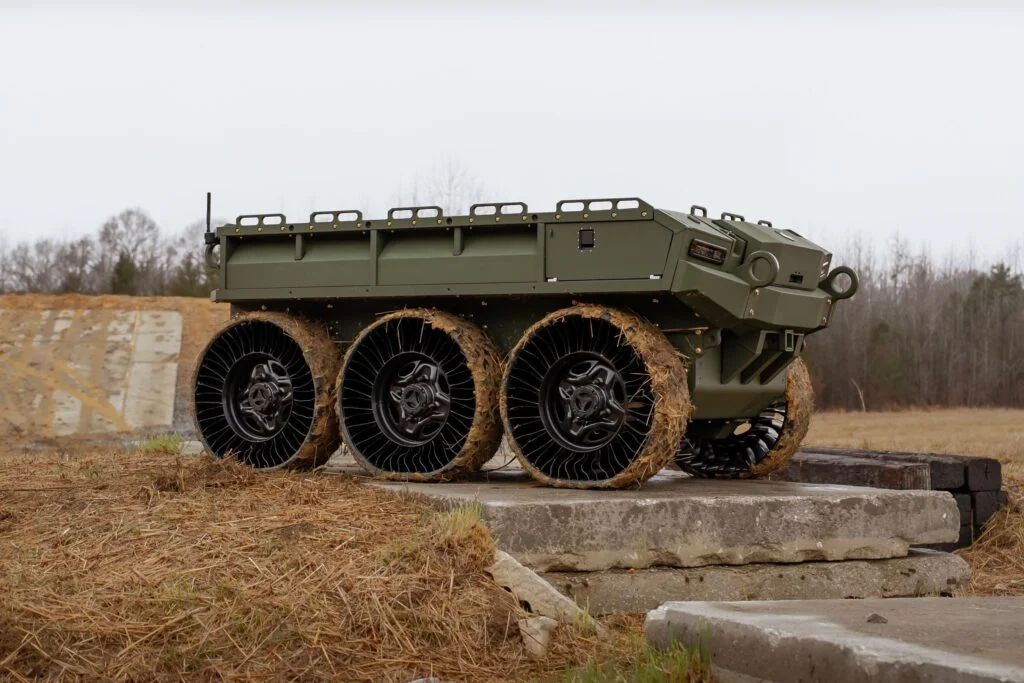
HDT Robotics announced delivery of its Hunter WOLF unmanned ground vehicles to the U.S. Army’s 3rd Brigade, 10th Mountain Division at Fort Polk, La., as part of the Army’s Ground Optionally Autonomous Transport program.

According to the company, the delivery supports a week-long Operator New Equipment Training event where soldiers will receive hands-on instruction operating, maintaining and deploying the robotic platform across multiple mission configurations.

Reducing the physical burden on soldiers while increasing operational flexibility remains central to HDT’s mission,” noted Tom Van Doren, president of HDT’s robotics sector. “We’re focused on giving soldiers a capability that helps them do their job while reducing their exposure to risk. The Hunter WOLF has gone through rigorous testing, is battlefield tested and ready now.”

The Hunter WOLF is a modular unmanned ground vehicle developed through its Advanced Battle Lab and designed to reduce soldier workload and extend operational endurance in the field. According to HDT, the platform can be configured for logistics transport, casualty evacuation, communications support and intelligence, surveillance and reconnaissance missions.

As part of the training exercise, HDT said soldiers will also work with autonomy kits and casualty evacuation systems while the company demonstrates autonomous navigation and operational capabilities tied to the Army’s broader Transformation in Contact modernization efforts.

Credit: HDT Robotics

Nomagic and Brack.Alltron Expand Partnership to Include Vision-Language-Action Systems for AI-Driven Robotics Automation

Insider Brief

  • Nomagic expanded its partnership with Swiss online retailer Brack.Alltron to deploy Vision-Language-Action systems in live warehouse operations as the companies scale AI-driven robotics automation for fulfillment tasks.
  • The expanded deployment is designed to help warehouse robots better interpret environments, adapt to changing inventory conditions and operate with greater autonomy across order picking and packing workflows.
  • Nomagic said its systems are now supporting autonomous warehouse operations during nights and weekends at Brack facilities, reflecting a broader shift toward always-on warehouse automation powered by physical AI and VLA robotics models.

PRESS RELEASE  — Nomagic, a leading robotics company applying advanced Physical AI to warehouse automation, announced a partnership expansion with Swiss online retailer, Brack.Alltron, to include Vision-Language-Action (VLA) systems in live warehouse operations, highlighting the growing need for this industry-transforming innovation.

Brack, the second-largest e-commerce platform in Switzerland, has been increasingly adopting Nomagic’s robotic solutions to automate key fulfillment processes, including order picking and packing. Expanding on its first deployments, the company is now scaling the use of advanced VLA capabilities to enable robots to better understand complex environments, adapt to changing inventory, and execute tasks with greater autonomy.

A defining feature of this collaboration has been the ability to extend operations beyond traditional working hours. Nomagic systems support autonomous warehouse activity during nights and weekends, including Sunday shifts, helping Brack reduce peak pressure and increase overall throughput.

“We have built a real partnership with Nomagic to integrate robotic picking into our operations, but the addition of VLA systems takes this to a new level,” said Roland Brack, Founder and Owner of Brack.Alltron. “In the past, our goal was simply to minimize manual intervention. Today, we are seeing robots that truly understand their environment. This intelligence allows us to run autonomous shifts through nights and Sundays, ensuring we stay ahead of peak demand without increasing the pressure on our human workforce.”

“Brack is a strong example of how AI-driven robotics can deliver real, measurable impact in production,” said Kacper Nowicki, CEO of Nomagic. “By expanding the use of VLA models across a range of use cases, we are setting the stage for a new generation of automation technology in warehouses worldwide.”

The collaboration reflects Nomagic’s broader strategic focus on Switzerland as a hub for innovation and deployment. Close collaborations with partners like Brack, combined with ongoing research and development efforts in the region, including the company’s recent Chief Scientist hire from Google DeepMind, is accelerating the advancement of VLA systems and their adoption in real-world logistics environments.

Nomagic’s technology is built on a Physical AI platform that continuously learns from live operations, enabling robots to adapt to dynamic warehouse conditions and handle millions of product variations with minimal human intervention. As global supply chains face increasing complexity and labor challenges, the expansion of Nomagic’s systems at Brack signals a broader industry shift toward intelligent, always-on automation powered by advanced AI.

The announcement is made in conjunction with Web Summit Vancouver, May 11-14, during which Nomagic CEO, Kacper Nowicki, will discuss how breakthroughs in Physical AI, including VLA models, are enabling robots to bridge the gap between digital intelligence and real-world execution at scale. He is scheduled to speak on the panel, “Humanoid vs. Purpose-built: What Wins in Robotics?,” on May 13 at 11:25 am PDT.

Infineon Startup Challenge 2026 Puts Humanoid Robotics in the Spotlight

Insider Brief

  • Infineon Technologies launched its 2026 Startup Challenge focused on humanoid robotics, bringing together startups working on sensing, motion control, perception and physical AI technologies with access to Infineon semiconductor platforms and development tools.
  • According to the company, the program is aimed at accelerating commercialization of robotics technologies spanning artificial sensing, sensor fusion, virtual interaction systems and precision motor control for humanoid and autonomous robotic systems.
  • Selected startups will participate in a multi-month development and mentoring program that includes access to hardware and software kits, technical support, investor exposure and pitch sessions with industry and deep-tech financing partners.

PRESS RELEASE — Infineon’s Startup Challenge brings together promising founder teams and young high-tech companies from across the globe to work jointly on a highly relevant topic: humanoid robotics. The Challenge is a structured innovation program designed to develop technological concepts into market-ready applications. It is part of Infineon’s global Co–Innovation Program, in which Infineon drives innovation together with startups as a technology and development partner.

“Semiconductors are the foundation of humanoid robotics and a key growth driver. Strategic collaboration with startups creates a win-win situation, combining novel ideas with industrially proven semiconductor technologies and thereby accelerating innovative, market-ready applications in this future-oriented field. Innovation does not occur in isolation, but rather where our customers’ challenges meet entrepreneurial courage, technological expertise and rapid implementation. The Startup Challenge is therefore a key pillar of our innovation culture,” says Sören Jehmlich, Vice President Ventures, Startups & Ecosystems at Infineon.

Technological focus areas of the challenge

The 2026 Challenge is aimed at emerging technology companies working on solutions for humanoid robotics, particularly in the following areas:

  • Artificial sensing: virtual skin and hand concepts based on advanced sensor technology
  • Environmental and situational perception using camera, radar, microphone and sensor fusion solutions
  • Virtual feedback and interaction mechanisms, for example using laser beam scanning projectors
  • Innovative motor control and motion technologies for precise, dynamic operations

“Humanoid robotics—or more broadly, physical AI—is a relevant topic for Infineon. In this young and dynamic market segment in particular, our semiconductor products offer clear advantages as system solutions for developing robotic applications: for example, in energy-efficient and precise actuation, sensing for environmental perception and system connectivity. In the Infineon Startup Challenge, young technology companies can transform their ideas into real, scalable applications using our hardware and software demo kits,” says Dirk Geiger, Senior Director & Team Lead Humanoid Robotics at Infineon.

From application to industrial application

Ambitious startups can submit their ideas up until 27 May 2026. Following the application phase, an expert jury will conduct a multi-stage selection process. The teams selected will take part in a multi-month technology and development program, gain access to Infineon technologies, prototyping kits as well as hardware and software solutions and will participate in pitch events and workshops.

Additionally, the teams will receive technical support and mentoring for prototype development, as well as business and presentation training. The program concludes with demo and pitch sessions, where results are presented to an expert audience of industry representatives, deep-tech investors and decision-makers.

Strong partner network and expert jury

The program is being implemented together with a network of technology, industry and financing partners. The jury combines deep technological expertise with entrepreneurial and strategic investment know-how. A key component of the Challenge is direct interaction with investors and financing partners from the deep-tech and innovation ecosystem. The goal is to make promising technologies visible at an early stage and support them during growth and scaling.

The program is supported within the framework of the Important Project of Common European Interest (IPCEI) for microelectronics and computer technology, which promotes the development of European innovation ecosystems, and other sources.

Further information and participation links: Applications are open until 27 May 2026 at www.infineon.com/SUC.

RoboStrategy Lists on Nasdaq With Portfolio of Robotics and Physical AI Companies in a Single Stock

Insider Brief

  • RoboStrategy has begun trading on the Nasdaq under the ticker symbol BOT as the investment fund seeks to give public market investors exposure to robotics and physical AI companies.
  • The closed-end fund is designed to provide concentrated exposure to a mix of private, pre-IPO and public robotics firms as many leading robotics startups remain privately held for extended periods.
  • RoboStrategy said its portfolio includes companies such as Figure AI, Apptronik, Standard Bots and Dexmate, with a focus on automation systems, humanoid robots and physical AI technologies.

RoboStrategy has begun trading on the Nasdaq under the ticker symbol BOT as the investment fund seeks to give public market investors exposure to robotics and physical AI companies.

According to RoboStrategy, since many robotics startups remain privately held for extended periods, the goal is to bring institutional-style robotics investing into public markets. The closed-end fund is focused on providing concentrated exposure to a mix of private, pre-IPO and public robotics companies.

RoboStrategy indicated its portfolio includes holdings tied to robotics and physical AI firms such as Figure AI, Apptronik, Dyna Robotics, Standard Bots and Dexmate, along with companies involved in autonomous systems and robotics supply chains.

RoboStrategy said its investment thesis centers on companies developing automation systems, humanoid robots and physical AI technologies that could reshape manufacturing, logistics and broader labor markets over the long term.

The fund’s common stock had not previously traded on a public exchange prior to the Nasdaq listing, according to the company.

Indian Construction Robotics Startup Flo Mobility Raises $2.5M in Funding

Insider Brief

  • Indian construction robotics startup Flo Mobility announced raising $2.5 million in new funding as the company expands deployment of autonomous material-handling systems across construction sites in India and international markets.
  • According to the company, the round included backing from Mela Ventures, Arali Ventures, ARTPARK, VentureGarage, JITO Incubation & Innovation Foundation and DEVX Ventures.
  • Flo Mobility said its material-handling robots are currently deployed across more than 25 construction sites while the company develops additional construction automation systems and expands collaborations with firms including L&T Construction, Godrej Properties and KEC International.

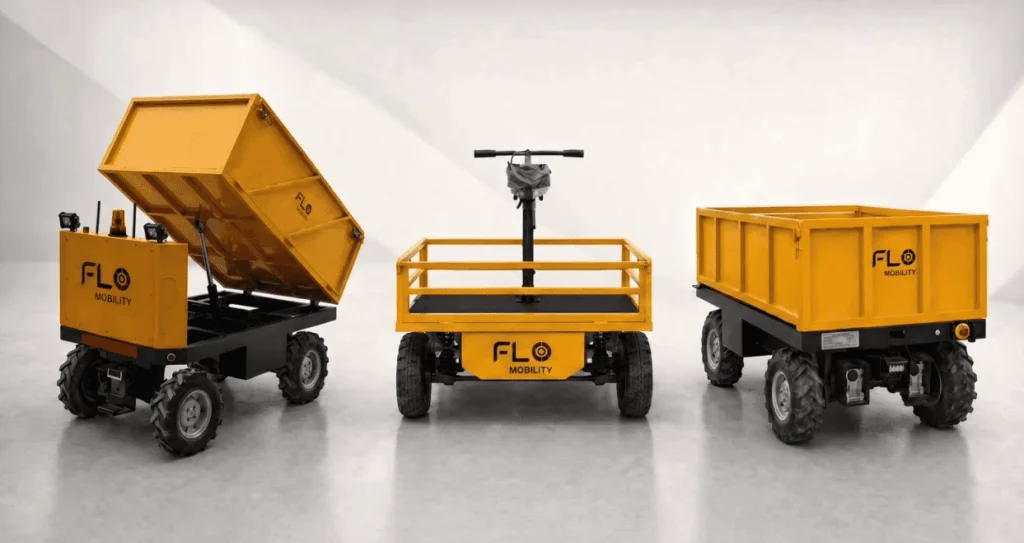
Indian construction robotics startup Flo Mobility announced raising $2.5M in new funding as the company expands deployment of autonomous material-handling systems across construction sites in India and international markets.

According to the company, the round included backing from Mela Ventures, Arali Ventures, ARTPARK, VentureGarage, JITO Incubation & Innovation Foundation and DEVX Ventures.

“We have starting with India and rapidly expanding into international markets, bringing next-generation construction automation to large and medium-scale projects worldwide,” the company noted. “Our material handling robot is already deployed at 25+ sites and we are in the prototyping stage for next one.”

Flo Mobility also cited deployments and collaborations with construction and real estate firms including L&T Construction, Sobha Ltd., Godrej Properties, Ahluwalia Contracts, Capacit’e Infraprojects, KEC International, Embassy Group, Shriram Properties, Leighton Asia, Total Environment Building Systems, Sowparnika Projects and Century Real Estate.

Image credit: Flo Mobility