Archives May 2026

OpenAI closes reasoning gap in voice agents

Read Online | Sign Up | Advertise

Good morning, {{ first_name | AI enthusiasts }}. Typing made AI useful, but speech is where agents have to prove they can keep up with real life.

OpenAI’s new real-time voice model trio is built for that messier interface, adding a major reasoning upgrade, the ability to talk while thinking, and capable tool use that moves AI voice agents closer to running tasks at the speed of natural conversation.


In today’s AI rundown:

  • OpenAI’s reasoning upgrade for voice agents

  • Google folds Fitbit into its AI health play

  • Test multiple AI models with same prompt

  • Anthropic plans for AI that builds itself

  • 4 new AI tools, community workflows, and more

LATEST DEVELOPMENTS

OPENAI

🗣️ OpenAI’s reasoning upgrade for voice agents

Image source: OpenAI

The Rundown: OpenAI just introduced GPT-Realtime-2, GPT-Realtime-Translate, and GPT-Realtime-Whisper, three API voice models that bring new reasoning, streaming, tool use, realism, and more capability upgrades to AI voice agents and live speech.

The details:

  • Realtime-2 brings GPT-5-level reasoning to live speech, is able to use multiple tools at once, talks while it thinks, and has better tone control for realism.

  • On Big Bench Audio, Realtime-2 hit 96.6% vs. 81.4% for its predecessor, a 15-point jump in how well voice AI can reason in real-time.

  • OpenAI also shipped a live translator covering 70+ languages and a streaming transcription model, rounding out a full voice-agent toolkit.

  • OAI said Zillow, Priceline, and Deutsche Telekom are already building on the models for real estate AI agents, voice-managed travel, and customer support.

Why it matters: AI voice’s turn-based era appears to be nearing a close, with OAI’s new model moving to systems that can reason better, leverage tools, and complete workflows without awkward interruptions that take users out of a natural flow. The AI industry is fixated on text agents, but the next wave will be spoken to, not typed at.

TOGETHER WITH AWS MARKETPLACE

📊 15+ enterprise leaders on getting data AI-ready

The Rundown: AWS Marketplace just released a free book featuring 15 chapters from senior data and AI leaders at JPMorgan Chase, Siemens, Mercedes-Benz, Roche, and more — each sharing practical advice on building the data infrastructure needed for agentic analytics and intelligent agents.

Chapters cover topics including:

  • Evolving data strategy for agentic AI and scaling data products

  • Building on existing infrastructure with a pragmatic, business-first approach

  • Unlocking value with classical ML, semantic layers, and cross-team alignment

  • Real-world perspectives from leaders across different industries

Get your free digital copy today.

GOOGLE

⌚️ Google folds Fitbit into its AI health play

Image source: Google

The Rundown: Google opened its AI health coach to the public after months in beta, integrating the Fitbit app into a new Google Health platform and pairing it with a new $99 screenless tracker that tracks and transmits body data to the AI.

The details:

  • Running on Gemini, the AI coach can tailor weekly workout routines, interpret uploaded medical records, and ID what a user ate from a phone photo.

  • Google is consolidating the Fitbit app, Health Connect, Apple Health, wearable data, and U.S. medical records into a single Google Health hub.

  • The new $99 Fitbit Air has no screen and weighs just 12g, carrying heart rate, oxygen, and temperature sensors that provide body data to the AI coach.

  • Apple Watch, Garmin, and Oura owners are set to get AI coach access later this year, with Google opening it up to hardware outside of its own.

Why it matters: AI’s role in personal health is only growing, and integrating everything under one roof can help Google make the AI layer the core product while also owning a trusted wearable line that provides users with the personalized guidance and context typically missing from other trackers and less connected options.

AI TRAINING

✏️ Test multiple AI models with same prompt

The Rundown: In this guide, you will learn how to use OpenRouter Fusion to test the same prompt across multiple AI models at once. Instead of opening five apps and guessing, you can compare outputs side by side and build a quick cheat sheet for work.

Step-by-step:

  1. Create an OpenRouter account, open OpenRouter Fusion, and pick how you want to pay for AI usage — OpenRouter credits or API keys you already pay for

  2. In Fusion, pick the models you want to compare — we tested Opus 4.7 vs. GPT 5.4 vs. Grok — and run one benchmark prompt at a time, keeping it identical

  3. Prompt something like: “You are advising a 20-person SaaS company deciding whether to replace its weekly status meeting with an async written update. Write a recommendation memo with 3 benefits, 3 risks, and a 2-week implementation plan. Keep it concise and practical”

  4. Open the responses, read the side-by-side analysis, and note which model is strongest. In the demo, about 10 comparisons cost around 40 cents

Pro tip: Run a few prompts you use all the time, write which model wins each task, and use OpenRouter’s model browser to compare price and speed before you spend more.

PRESENTED BY WEIGHTS & BIASES

🐝 New guide: Tools and workflows to develop AI agents

The Rundown: AI agents can dramatically boost productivity and innovation, but getting them into the real world takes a lot of iteration. Whether you’re exploring agents for the first time or refining your current approach, this primer delivers actionable insights to help your team succeed and thrive in the AI era.

Get the guide to learn:

  • What defines agentic applications and why observability matters

  • A proven workflow for building agentic AI applications

  • How pioneering companies are building and deploying AI agents today

Download a primer on building successful AI agents.

THE ANTHROPIC INSTITUTE

🔬 Anthropic plans for AI that builds itself

Image source: Anthropic

The Rundown: Anthropic’s newly formed research arm, The Anthropic Institute, published its formal research agenda — a document that treats the possibility of AI systems improving themselves as something the company is actively preparing for.

The details:

  • TAI sits inside Anthropic, letting researchers study Claude usage, internal workflows, and security signals before they hit the wider market.

  • The Institute’s agenda spans security threats, economic disruption, governance, and planning for self-improving models.

  • The team also proposed Cold War-style hotlines between labs and governments, plus “fire drill” exercises for sudden capability surges.

  • TAI said it is committed to publishing Economic Index data, monthly worker surveys, threat research, and more details on its own internal AI-boosted R&D.

Why it matters: We wrote earlier about Anthropic co-founder Jack Clark’s blog on self-improving systems, and TAI’s research agenda puts it very much into focus. Anthropic’s talk of “fire drills” and Cold War-style systems is to prepare for an “intelligence explosion” that we might be heading to faster than many expected.

QUICK HITS

🛠️ Trending AI Tools

  • ✈️ Serko.ai – The AI travel assistant that plans, books, and manages your entire business trip, so you can skip the busywork*

  • 🗣️ GPT-Realtime-2 – Voice AI that thinks, calls tools, maintains convo flow

  • 🎥 Studio Agent – ElevenLabs’ AI editor to draft videos, places sound effects

  • 🎆 Grok Imagine Quality Mode – xAI’s Image generation with higher realism

*Sponsored Listing

📰 Everything else in AI today

Spotify launched ‘Personal Podcasts’, a tool allowing agents to turn items like briefings or class notes into a personal podcast directly inside users’ Spotify libraries.

OpenAI introduced Trusted Contact, an opt-in ChatGPT feature that alerts a designated friend or family member if signs of self-harm risk are detected.

Scale AI landed a $500M Pentagon contract for military data analysis, marking a 5x jump from last September’s $100M deal.

Perplexity rolled out its Personal Computer to all Mac users, allowing it to take agentic action across a user’s local computer, files, and via the Comet browser.

Mozilla published a blog about using Claude Mythos Preview for security, saying the model patched more bugs in April than the past 15 months combined.

COMMUNITY

🤝 Community AI workflows

Every newsletter, we showcase how a reader is using AI to work smarter, save time, or make life easier.

Today’s workflow comes from reader Tatiana B. in San Francisco, CA:

“I’m COO of a startup and mom to a two-and-a-half-year-old. Managing both is a lot, and keeping track of everything I need to do at home on top of work can be a real mental drain.

So I use AI to help me compile a document covering everything I need help with at home: my daughter’s meal preferences, her daily routine, and house chores. I treat it like a work project, going back and forth with AI to think through what I actually need done, fill in gaps I hadn’t thought of, and get it all out of my head into something I can hand to someone else.

Now, when someone new comes to help at home, I don’t have to explain everything from scratch. That frees me up to actually be present with my daughter when I’m with her, and focused on work when I’m not. I also know I’m lucky to be in a position to hire help, but using AI to think clearly about what you need and get it out of your head is something anybody can do.”

How do you use AI? Tell us here.

🎓 Highlights: News, Guides & Events

  • Read our last AI newsletter: Anthropic, SpaceXAI become unlikely partners

  • Read our last Tech newsletter: GameStop’s wild bid to buy eBay

  • Read our last Robotics newsletter: Genesis robot makes breakfast

  • Today’s AI tool guide: Test multiple AI models with the same prompt, fast

See you soon,

Rowan, Joey, Zach, Shubham, and Jennifer — the humans behind The Rundown

Anthropic, SpaceX(AI) become unlikely compute partners

Read Online | Sign Up | Advertise

Good morning, {{ first_name | AI enthusiasts }}. Just months ago, Elon Musk was posting that Anthropic “hates Western Civilization” and should be renamed “Misanthropic”. Now, he’s renting them his entire Colossus 1 compute cluster.

The new deal pulls off three things at once: patching Claude’s compute problems, hurting Musk’s nemesis OAI by feeding its biggest rival, and signaling a new compute-landlord business for SpaceXAI even as Grok keeps chasing the frontier.


In today’s AI rundown:

  • Anthropic, SpaceX partner in new compute deal

  • Mira Murati speaks out in Musk vs. OpenAI trial

  • Use Claude Design’s slide decks feature like a pro

  • DeepMind picks EVE Online game as next AI testbed

  • 4 new AI tools, community workflows, and more

LATEST DEVELOPMENTS

ANTHROPIC & SPACEX

🔌 Anthropic, SpaceX(AI) partner in new compute deal

Image source: Images 2.0 / The Rundown

The Rundown: Anthropic just signed a deal with SpaceX to lease its Colossus 1, raising Claude usage and putting Musk and Anthropic on one team months after he said that Anthropic should be called “Misanthropic” and it “hates Western Civilization.”

The details:

  • Anthropic will lease all of Colossus 1, a 300+ MW Memphis supercluster, with more than 220K Nvidia GPUs coming online within the month.

  • Anthropic said Claude Code’s 5-hour usage caps are now doubling across paid tiers, with additional increases via API and no more peak-hour restrictions.

  • Musk replied on X that SpaceX will rent compute to “AI companies that are taking the right steps to ensure it is good for humanity.”

  • The Information also reported yesterday that Anthropic is committing to a $200B, 5 GW compute deal over the next five years with Google Cloud.

Why it matters: This is a fascinating partnership from several angles. One being Musk taking the ‘enemy of my enemy is my friend’ approach — helping patch OAI’s biggest rival’s glaring compute hole. Another is SpaceXAI (apparently the new name), moving to providing compute for rivals while still pushing to get Grok near the frontier.

TOGETHER WITH STRIPE

🏷️ A five-step framework for pricing AI products

The Rundown: Pricing AI products means making a series of connected decisions—how you charge, how you match prices to value, and how you adapt as costs and the market shift. Stripe’s new framework outlines 5 steps for pricing AI products.

In this guide, you’ll learn:

  • How AI leaders like Anthropic, Clay, and Vercel approach their pricing

  • Strategies to align what you charge with the exact value you deliver

  • Steps to pick a pricing model that balances ease of user adoption with repeatable revenue

Get the framework.

ELON MUSK VS. OPENAI TRIAL

🏛️ Mira Murati speaks out in Musk vs. OpenAI trial

Image source: Reuters

The Rundown: Ex-OpenAI CTO Mira Murati testified Wednesday via video deposition in Elon Musk’s lawsuit against OpenAI, accusing CEO Sam Altman of lying about a model’s safety review, undermining her authority, and pitting execs against one another.

The details:

  • Murati said Altman told her OAI’s legal team cleared a model to skip safety review, which she later verified with counsel Jason Kwon was false.

  • She also described Altman giving conflicting directions to different execs, making her role as CTO harder and creating chaos across OAI’s leadership.

  • Murati briefly became interim CEO during Altman’s 2023 firing, but said the board process put OpenAI “at risk of falling apart.”

  • Former OAI board member Helen Toner also testified, reportedly criticizing Murati as “afraid to stick her neck out” and scared of “blowback for her career”.

Why it matters: The 2023 board drama is the saga that will never conclude, and Murati’s testimony is a powerful voice to aid Musk’s argument that Altman and co. are untrustworthy. But whether that ultimately means anything related to Musk’s claims of Altman and Brockman “trying to steal a charity” in 2017 is up for the jury to decide.

AI TRAINING

👨‍💻 Use Claude Design’s slide decks feature like a pro

The Rundown: In this guide, you will learn how to use Claude Design to turn your raw data into a useful strategy deck complete with actual insights. Claude Design analyzes what is working and gives concrete recommendations your team can use.

Step-by-step:

  1. Start with one CSV or spreadsheet with a messy report (YT channel data, Facebook ads, etc.) and decide what the deck needs to do (like find patterns)

  2. Open claude.ai/design, choose Slide deck, skip the design system, toggle on speaker notes, and upload your data

  3. Prompt: “Turn these files into a strategy deck on performance. Analyze the results by item and extract best practices from the data and assets. Use charts, rankings, and concrete recommendations. Match images or creative files to CSV using the filename or matching field. Keep it presentation-ready”

  4. Generation will take 10-15 minutes. You can export to PowerPoint or Google Slides when it’s ready

Pro tip: Duplicate the project and upload more data sources for Claude to incorporate into the presentation.

PRESENTED BY IBM

🔌 Rewire the C-suite for an AI-first world

The Rundown: Most leaders know AI will reshape their business, but few have a clear playbook for how. An IBM Institute of Business Value analysis reveals 5 plays that CEOs must fulfill now for payoffs by 2030.

To lead in an AI-first landscape, surveyed CEOs suggest:

  • Customize your AI mix, not just your AI models

  • Hire a Chief AI Officer if you haven’t already

  • Orchestrate intelligence —both artificial and human

Get deeper details in the 2026 CEO Study.

GOOGLE DEEPMIND

🛸 DeepMind picks EVE Online game as next AI testbed

Image source: Fenris Creations

The Rundown: Google DeepMind picked up a minority stake in Fenris Creations, a game studio spinoff from CCP Games, which makes the popular EVE Online — with DeepMind set to use the 23-year-old space game as a sandbox for AI research.

The details:

  • EVE Online has run for two decades on a single server where players form corporations, set market prices, and torch six-figure fleets in day-long battles.

  • DeepMind’s investment will come with AI agent runs on an offline EVE clone, testing how models reason over long timelines, retain memory, and learn.

  • Demis Hassabis cited Atari DQN, AlphaGo, AlphaStar, and SIMA as game-bred DeepMind wins, calling games “the perfect training ground” for AI algorithms. 

  • Fenris’ CEO pitched EVE as “one of the few environments” where intelligence can be tested “inside something that already behaves like a living world”.

Why it matters: DeepMind has been here before with Go, Atari, StarCraft, and SIMA, but EVE is not a match to win as much as a 23-year-old living, evolving society to understand. That makes the Fenris deal a natural next step in the shift from game-playing AI to agents that can operate inside less predictable real-life systems.

QUICK HITS

🛠️ Trending AI Tools

  • 🧠 Memoket – Stop briefing AI from scratch. Memoket captures conversations and remembers context. Try the app for free today*

  • 🤖 Claude Managed Agents – Pre-built agent harness with ‘dreaming’ memory

  • ⚡️ GPT 5.5 Instant – OpenAI’s new default model across ChatGPT

  • 🎧 Realtime TTS-2 – New voice AI that listens to match user tone and emotion

*Sponsored Listing

📰 Everything else in AI today

Subquadratic debuted SubQ, a model the company claims has a 12M token context window and a 52x speed boost on long tasks at a fraction of the cost over rivals.

Anthropic launched dreaming, outcomes, and multi-agent orchestration for Managed Agents, letting agents study past sessions, grade work, and split complex jobs.

OpenAI teamed up with AMD, Intel, NVIDIA, Microsoft, and Broadcom to open-source MRC, a tool that keeps giant AI training runs going when hardware fails mid-session.

Chinese AI startup DeepSeek is reportedly nearing a new funding round that would value the company at as high as $45B.

Google announced a new partnership with TuneCore parent Believe to put its Flow Music and Lyria 3 Pro model in front of artists.

COMMUNITY

🤝 Community AI workflows

Every newsletter, we showcase how a reader is using AI to work smarter, save time, or make life easier.

Today’s workflow comes from reader Anonymous:

“I’m recovering from a torn ACL, and my physiotherapist films all of my exercises and sends the videos to me on WhatsApp, narrating the sets/reps and notes on how to perform the exercise properly.

I uploaded the videos into Gemini and got it to build a prompt for Claude Code, which one-shotted an app that I now use to track sets, reps, weights from last workouts, notes, over multiple months. I can then export this data into a .csv for my physio before we check back in with each other.”

How do you use AI? Tell us here.

🎓 Highlights: News, Guides & Events

  • Read our last AI newsletter: OpenAI’s AI phone just jumped the line

  • Read our last Tech newsletter: GameStop’s wild bid to buy eBay

  • Read our last Robotics newsletter: Meta buys a humanoid brain

  • Today’s AI tool guide: Use Claude Design’s slide decks feature like a pro

See you soon,

Rowan, Joey, Zach, Shubham, and Jennifer — the humans behind The Rundown

OpenAI’s AI phone just jumped the line

Read Online | Sign Up | Advertise

Good morning, {{ first_name | AI enthusiasts }}. Amid intensifying competition with Anthropic, improved models, and efforts to kill “side hustles,” OpenAI is apparently looking at something closer to home — an AI agent phone.

Analyst Ming-Chi Kuo says the company is fast-tracking this device for 2027, with some notable capabilities. Good news for those wanting a stronger AI experience in their pockets. The question is: where does this leave the ongoing work with Jony Ive? Or is this the same device?


In today’s AI rundown:

  • OpenAI fast-tracks its ‘AI agent phone’

  • Anthropic’s AI agents for finance work

  • Make your Notion agents more autonomous

  • Home-based ‘mini’ AI data centers are coming

  • 4 new AI tools, community workflows, and more

LATEST DEVELOPMENTS

OPENAI

📱 OpenAI fast-tracks ‘AI agent phone’

Image source: Images 2.0 / The Rundown

The Rundown: OpenAI is reportedly accelerating development of its first AI phone, now aiming for mass production in the first half of 2027, which is a full year earlier than previously reported, according to supply chain analyst Ming-Chi Kuo.

The details:

  • Kuo says the timeline shift is likely driven by OAI’s IPO ambitions (strong hardware could strengthen investor pitch) and rising competition in AI phones.

  • The phone’s standout spec will be its image signal processor, with an enhanced HDR pipeline to improve AI agents’ real-world visual sensing.

  • MediaTek is positioned to be the sole chip supplier, with the device using two AI processors to handle vision and language tasks simultaneously.

  • Kuo also added that OpenAI’s combined 2027–28 shipments of this phone could touch 30M, if the development stays on track.

Why it matters: Controlling hardware and OS could be the key to a true agentic phone. But if OpenAI’s AI phone is closer than we thought, where does this leave the device it’s building with Jony Ive’s io? OpenAI acquired io last year with much fanfare to go “beyond screens,” but nothing concrete has appeared so far except a few rumors.

TOGETHER WITH LAMBDA

How to push Model FLOPS Utilization past 50%

The Rundown: Most large-scale training runs operate at just 35–45% Model FLOPS Utilization, meaning teams pay for more than twice the compute they actually use. Lambda’s engineers benchmarked Llama 3.1 models from 8B to 405B on NVIDIA Blackwell GPUs to trace efficiency loss to its root causes.

Efficiency losses were traced to:

  • Memory overhead capping effective throughput

  • Parallelism strategies misaligned with the hardware

  • Serialized communication stalling GPU cycles

Get the guide.

ANTHROPIC

🤑 Anthropic’s AI agents for finance work

Image source: Anthropic

The Rundown: Anthropic just unveiled 10 ready-to-run AI agents aimed squarely at financial services and insurance — capable of handling work ranging from building pitchbooks and screening KYC files to reviewing earnings and valuations.

The details:

  • Each agent comes with task-specific domain skills and instructions, connectors to relevant data sources, and add-on Claude models for sub-tasks.

  • Firms can adapt any agent of their choice to their own modeling conventions, risk policies, and approval flows — while staying in the loop 24/7.

  • The agents can be used as plugins within Claude Cowork or Claude Code on desktop, or as cookbooks, running as Managed Agents on the Claude platform.

  • Claude is also getting an add-in for Microsoft 365 as well as data connectors from Dun & Bradstreet, Verisk, IBISWorld, and other financial services partners.

Why it matters: Development, cybersecurity, design, and now finance. Anthropic is going domain by domain, meeting businesses where they are instead of selling a general model and letting them figure it out. Its new $1.5B joint venture alongside Wall Street giants reinforces this strategy, further fueling its race with OpenAI.

AI TRAINING

🤖 Make your Notion agents more autonomous

The Rundown: In this guide, you will learn a hidden workflow that will make your Notion Agents more autonomous and powerful than they are by default. This lets you wake up any agent, give it tasks, and then get a report on what it did.

Step-by-step:

  1. Create a Notion agent from the “Agents” option in the sidebar. Then, open a database for the agent’s prompt and task reports. Ours is called “reports”

  2. Click the New dropdown, open Templates, and create a @Today template (ours was Daily Summary). @Today makes duplicates inherit the current date

  3. Set the properties, write task instructions in the page body, and @ mention the agent, so the duplicate triggers it. Remember to stop the agent when doing this, so it doesn’t overwrite the template

  4. From the template, click New template, then Duplicate, and pick a cadence. We run ours daily at 7 a.m. A small blue icon next to the template shows it’s live

Pro tip: Try setting up daily debriefs, weekly reports, and email automations. Now you can route them all through the same planning agent.

PRESENTED BY IBM

🔌 Rewire the C-suite for an AI-first world

The Rundown: Most leaders know AI will reshape their business, but few have a clear playbook for how. An IBM Institute of Business Value analysis reveals 5 plays that CEOs must fulfill now for payoffs by 2030.

To lead in an AI-first landscape, surveyed CEOs suggest:

  • Customize your AI mix, not just your AI models

  • Hire a Chief AI Officer if you haven’t already

  • Orchestrate intelligence — both artificial and human

Get deeper details in the 2026 CEO Study.

AI DATA CENTERS

🏘️ Home-based ‘mini’ AI data centers are coming

Image source: Span

The Rundown: California startup Span is teaming up with Nvidia to install mini AI data centers on the walls of residential homes and small businesses, tapping unused electrical capacity on local grids to meet surging AI compute demand.

The details:

  • Span has developed XFRA, small compute nodes that mount on the exterior walls of homes, alongside accompanying HVAC and electrical systems.

  • Nvidia is providing its liquid-cooled RTX PRO 6000 Blackwell Server Edition GPUs to power each XFRA box, ensuring noiseless computing for AI workloads.

  • Span told CNBC it can install 8,000 XFRA units 6x faster and at one-fifth the cost of building a comparable 100MW centralized data center facility.

  • Currently, the company is working with PulteGroup, one of the largest U.S. homebuilders, to test the box and its economics in newly built communities.

Why it matters: Grid strain from data centers is real, and Span’s boxes could spread the load while tapping only unused capacity. But public response is an open question — not all will love the idea of a data center box mounted where kids play, especially when alternatives like ocean- and space-based data centers are also in sight.

QUICK HITS

🛠️ Trending AI Tools

  • 🚀 Box Automate – Orchestrate agentic workflow automation, securely and at scale*

  • 🎨 Pomelli – Make product-specific campaigns with Google’s AI marketing tool

  • 🖼️ Uni 1.1 – Luma’s new image generation and editing AI that nears the frontier

  • 🎮️ Astrocade – Platform to create shareable games with AI

    *Sponsored Listing

📰 Everything else in AI today

OpenAI’s GPT-5.5-Instant started rolling out to all ChatGPT users, bringing improved performance, stronger memory, and more personalized, concise responses.

Microsoft expanded its Copilot Cowork agentic system to iOS and Android, while adding built-in skills for common tasks and data plugins for business systems.

Apple agreed to pay some U.S. iPhone buyers a collective $250M to settle a class action lawsuit over misleading claims about its new AI Siri, but admitted no wrongdoing.

Perplexity AI launched Computer for Professional Finance, bringing licensed data and 35 dedicated workflows to its agentic system to help analysts handle routine work.

Anthropic reportedly committed to spending $200B on Google’s cloud and chips over the next five years, now making 40%+ of Google’s revenue backlog.

Coinbase CEO Brian Armstrong said the company is cutting 14% of its workforce, ~700 people, as it shifts to AI-native teams, agent-driven workflows, and leaner ops.

COMMUNITY

🤝 Community AI workflows

Every newsletter, we showcase how a reader is using AI to work smarter, save time, or make life easier.

Today’s workflow comes from reader Schy W. in Springfield, IL:

“I went to a music festival — multiple stages, music over several days. Many bands had more than one set time/location. I fed Claude the festival’s schedule PDF and told it to extract the information, but to ignore autograph signing and music workshops. I then read off a list of bands I wanted to see and followed up with a subset of those that I absolutely did not want to miss. I requested a schedule that would plan out where I should be to maximize the number of bands I could reasonably see with a simple prompt.

It understood the mission and in one stroke produced a fantastic spreadsheet optimizing my time and noting my priorities, stages, times, partial sets, if a band has another set, and explained the decision-making rationale.”

How do you use AI? Tell us here.

🎓 Highlights: News, Guides & Events

  • Read our last AI newsletter: AI data centers head for the ocean

  • Read our last Tech newsletter: GameStop’s wild bid to buy eBay

  • Read our last Robotics newsletter: Meta buys a humanoid brain

  • Today’s AI tool guide: Make your Notion agents more autonomous

See you soon,

Rowan, Joey, Zach, Shubham, and Jennifer — the humans behind The Rundown

AI data centers head for the ocean

Read Online | Sign Up | Advertise

Good morning, {{ first_name | AI enthusiasts }}. AI’s land grab is running into walls — literal ones, in the form of an angry public fed up with data center constructions in their cities.

Oregon-based startup Panthalassa is taking things offshore instead, with Peter Thiel leading a new $140M round for floating structures that turn ocean energy into the compute AI companies are all scrambling for more of.


In today’s AI rundown:

  • Thiel-backed startup brings AI data centers to sea

  • Anthropic co-founder forecasts AI’s self-building era

  • How to replace Siri with a free local model

  • OAI, Anthropic launching rival private equity ventures

  • 4 new AI tools, community workflows, and more

LATEST DEVELOPMENTS

PETER THIEL & PANTHALASSA

🌊 Thiel-backed startup brings AI data centers to sea

Image source: Panthalassa

The Rundown: PayPal and Palantir founder Peter Thiel just led a $140M Series B for Panthalassa, an Oregon-based startup that builds autonomous floating compute structures powered by ocean waves — reportedly valuing the company at nearly $1B.

The details:

  • Each 85-meter steel node bobs in open ocean, converting wave motion into electricity for onboard AI chips, all cooled naturally by seawater.

  • Once deployed, the nodes can steer themselves to remote waters using only their hull shape (no engines) and beam AI results back via SpaceX’s Starlink.

  • The raise will finish a pilot factory near Portland and deploy the first wave-powered compute nodes in the Pacific Ocean, with commercial rollout in 2027.

  • Thiel told the Financial Times that “extraterrestrial solutions (to compute) are no longer science fiction” and that “Panthalassa has opened the ocean frontier.”

Why it matters: AI data centers have been one of the more controversial AI talking points for the general public, and the hostility towards their construction is growing fast. While both Elon Musk and Google have pushed space-based options, those are still far from reality, making the ocean an interesting and more realistic alternative.

TOGETHER WITH YOU.COM

 API latency is only part of the story

The Rundown: Most teams pick an API by checking a benchmark table and calling it done—a shortcut that could miss what really matters in production. This guide from You.com explains why raw latency is a misleading signal and what to measure instead.

What you’ll learn:

  • Why p50 latency hides the failures your users actually experience

  • The “time-to-useful-result” framework that captures what benchmarks leave out

  • Four hidden cost drivers that show up in your logs, not vendor tables

  • How to evaluate APIs at your actual concurrency levels, not the demo conditions

Learn what to measure instead. Download the guide.

ANTHROPIC

📝 Anthropic co-founder forecasts AI’s self-building era

Image source: Jack Clark (@JackclarkSF on X) / The Rundown

The Rundown: Anthropic co-founder Jack Clark published a new blog post on self-improving AI, putting 60%+ odds on AI systems training their own successors before 2029, citing public data showing AI is already handling a range of core R&D tasks.

The details:

  • Clark built the case on public papers and benchmark data, charting AI going from near-zero to 100% across core development tasks in under 3 years.

  • METR data shows AI’s independent work capability went from 30-second tasks in 2022 to 12 hours in 2026, with 100-hour runs projected by year-end.

  • Clark also pointed to the SWE-Bench benchmark (real GitHub coding), moving from Claude 2 at 2% to Mythos Preview at 93.9% in under three years.

  • OpenAI is also targeting an automated research intern by Sept. 2026, while startups like Recursive Superintelligence share similar self-improvement goals.

Why it matters: Self-improving AI systems feel like the inflection point that really makes model development go exponential, and “by the end of 2028” is not that far away. AI is already moving at a speed that is hard for most to process — but once it can reliably build and train itself, all bets are off for how fast things can truly move.

AI TRAINING

📲 How to replace Siri with a free local model

The Rundown: In this guide, you will learn how to download a free AI model to your iPhone and bind it to your phone’s action button like Siri. The model is installed locally, so you will be able to use it without the internet or sending out your private data.

Step-by-step:

  1. Download Locally AI from the App Store, choose your model. You can start with Google’s new, open-source Gemma model, which typically works great

  2. Download the AI and keep the app open. Now, open settings, search for Action Button, swipe to the Shortcut option, search Locally AI, and choose Voice Mode

  3. Press the Action Button on your iPhone and wait for the chime. The app will ask you to download a speech-to-text model the first time. Download it

  4. Now try asking the model a question. We found they are best for explaining concepts, translation tasks, and math

Pro tip: Download a bigger model and run the same prompt through it. Compare speed, storage size, and answer quality to get the perfect AI for your iPhone.

AI & THE ENTERPRISE

💰 OAI, Anthropic launching rival private equity ventures

Image source: Images 2.0 / The Rundown

The Rundown: Anthropic announced the formation of a new Claude services company with Blackstone, Hellman & Friedman, and Goldman Sachs, with OpenAI also reportedly raising for its own PE-backed ‘Deployment Company’ the same day.

The details:

  • The $1.5B Anthropic venture will focus on mid-sized companies, pairing its Applied AI engineers with teams building custom Claude workflows.

  • OAI’s “Deployment Company” will reportedly bring in $4B from 19 investors at a $10B valuation, including TPG, Brookfield, Bain, and SoftBank.

  • Both models would give the frontier AI labs direct paths into portfolio companies that often lack the in-house talent to deploy AI systems alone.

Why it matters: The barriers for companies aren’t the models anymore, but actually getting it installed and integrated into messy, large-scale businesses. These paths look more like frontier labs creating their own AI-native consulting firms, with a wealth of private equity portfolio companies ready to get in on the action.

QUICK HITS

🛠️ Trending AI Tools

  • 🗣️ Unwrap Customer Intelligence – Get AI-driven insights from your unstructured customer feedback to build your product roadmap*

  • 🚀 Grok 4.3 – xAI’s AI with strong cost efficiency, domain-specific performance

  • 🤖 Cofounder 2 – General Intelligence’s new agent orchestrator for businesses

  • 🦮 Codex Pets – OpenAI’s animated companions for tracking Codex work

*Sponsored Listing

📰 Everything else in AI today

A new filing in the Elon Musk vs. OpenAI case showed that Musk reached out to OAI President Greg Brockman about a potential settlement days before the trial.

The New York Times reported that the White House is seeking to create a formal review and oversight process prior to companies publicly deploying AI models.

Sierra raised $950M at a $15B valuation, with the platform saying it now serves over 40% of the Fortune 50 companies for AI-driven customer experiences.

Roomba creator and former iRobot CEO Colin Angle introduced the Familiar, a bulldog-sized AI pet robot targeting retirees who’ve aged out of pet ownership.

Anthropic is reportedly in talks to purchase chips from Fractile, a three-year-old London startup focused on more efficient chips for running AI models.

COMMUNITY

🤝 Community AI workflows

Every newsletter, we showcase how a reader is using AI to work smarter, save time, or make life easier.

Today’s workflow comes from reader Adam M. in Berlin, Germany:

My best friend Eric was in a horse riding accident, which has left him partially paralyzed from the neck down. His medical insurance would only cover some of it. He was in a remote place in South Africa, so he needed to be flown by helicopter to the nearest hospital and then undergo multiple surgeries.

We used AI to help us set up the GoFundMe page and create social media posts for him, and to manage his ongoing recovery. Given that he can’t really use his hands, he’s able to use his phone now with AI to give updates and share about his journey with the world so that we can get the message out there to help him recover.

We’re also using it to stay up to date with GoFundMe and their documentation and what they need to prove that he’s a real person and that it isn’t a scam. Whenever they send requests, we can paste them into Claude and get a properly formatted answer back so they can speed up the approval process, release their funds, and make sure they’re happy.

It also helped us estimate what we should do in terms of a goal. We’ve set the goal at half a million euros, and we are well on the way.”

How do you use AI? Tell us here.

🎓 Highlights: News, Guides & Events

  • Read our last AI newsletter: AI shows its skills in the emergency room

  • Read our last Tech newsletter: SpaceX is about to crash into the Moon

  • Read our last Robotics newsletter: Meta buys a humanoid brain

  • Today’s AI tool guide: How to replace Siri with a free local model

See you soon,

Rowan, Joey, Zach, Shubham, and Jennifer — the humans behind The Rundown

AI shows its skills in the emergency room

Read Online | Sign Up | Advertise

Good morning, {{ first_name | AI enthusiasts }}. AI just beat two attending emergency room physicians across real patient cases in a new Harvard study. The model? OpenAI’s o1-preview, released in… 2024.

Millions of users are already turning to ChatGPT for health advice every day, but the data shows that AI models (preferably not several generations behind) may be ready for a more formal seat in the exam room alongside the doctor as well.


In today’s AI rundown:

  • Old AI model tops doctors in ER trial

  • The Rundown Roundtable: Our AI use cases

  • Create converting landing pages in Claude

  • Pentagon announces new AI partners

  • 4 new AI tools, community workflows, and more

LATEST DEVELOPMENTS

OPENAI

🏥 Old AI model tops doctors in ER trial

Image source: Images 2.0 / The Rundown

The Rundown: A Harvard study published in Science just put OpenAI’s o1-preview (released in 2024) through 76 real ER cases, with the AI diagnosing patients more accurately than two physicians, despite using only raw electronic health-record text.

The details:

  • The study compared OpenAI’s o1-preview model with two attending physicians across 76 real ER cases and three decision stages of patient care.

  • At initial ER triage, the model gave the correct diagnosis 67.1% of the time, compared to 55.3% and 50.0% for the two physicians.

  • The two separate physician reviewers tasked with scoring couldn’t tell which diagnoses came from the model and which came from the humans.

  • In one case, the AI flagged a rare flesh-eating infection in a transplant patient roughly 12 to 24 hours before the treating doctor caught it.

Why it matters: Millions of people are already using AI daily for health questions, but studies like these are showing the usefulness can also flow the other way to the doctors themselves. If a model generations behind is already beating ER doctors, imagine what the frontier could look like inside the patient care process.

TOGETHER WITH UNWRAP

⚡️ See how Oura automates customer feedback analysis

The Rundown: Unwrap’s customer intelligence platform that pulls all your feedback – surveys, reviews, support tickets, social comments– into one view, then uses AI to surface the most actionable insights to deliver them to your inbox. Teams at Perplexity, Stripe and DoorDash rely on Unwrap to ensure no customer voice gets lost.

With Unwrap you get:

  • All customer feedback automatically categorized

  • Query feedback using Unwrap Assistant, or in your favorite tools using Unwrap’s MCP

  • Real-time alerts from feedback as they arise

  • A clear view of customer sentiment

Unwrap is offering a trial of its tools to Rundown AI subscribers! Grab 15 minutes with the team to get set up.

THE RUNDOWN ROUNDTABLE

💡 The Rundown Roundtable: Our AI use cases

Image source: Ideogram / The Rundown

The Rundown: The Rundown Roundtable is a weekly feature where we poll members of The Rundown staff about how we use AI in our work and daily lives.

Jennifer, Tech & Robotics Writer: Last year, my daughter was diagnosed with a rare autoimmune disease. Like any parent in that situation, I wanted to understand everything I could so we could make the best decisions for her care. I used both Gemini and ChatGPT to help me sort through the medical literature, treatment options, possible side effects, and how other countries approach treatment.

I also turned to ChatGPT to identify the leading specialists in the country — thankfully, our referred doctor turned out to be one of them, which gave us even more reassurance. More than anything, it helped demystify the disease and make us feel confident that we were doing everything we could. She’s doing really well on her medications, and seeing her recover has been an enormous relief.

Shubham, Editor: I use ChatGPT as a label-reading filter for packaged snacks, uploading product photos and asking it to flag hidden sugars, oils like palm, and preservatives, then compare options against a strict checklist of clean ingredients, minimal processing, and decent macros.

It’s especially useful for decoding lesser-known, jargon-heavy terms on the back label, translating things like INS numbers, stabilizers, and emulsifiers into plain English so it’s clear what’s actually being consumed. Instead of trusting front-of-pack claims like “multigrain” or “sugar-free,” it breaks down what’s inside, surfaces trade-offs, and narrows choices to the best options available online

AI TRAINING

🎨 Design converting landing pages in Claude

The Rundown: In this guide, you will learn to use Anthropic’s new AI design tool — Claude Design — to generate four, high-converting mockup variations of your website’s landing page.

Step-by-step:

  1. Go to claude.ai/design, select wireframe, click create, and describe who the page is for, the product, and the action visitors should take. Don’t hit “Send”

  2. Screenshot a landing page you like (search top pages in your niche), as well as a page that does millions of daily transactions, like Amazon or eBay

  3. Hit send with the brief and screenshots. Tell Claude to give four variations of the mockup. Answer any follow-up questions and wait 2-5 minutes

  4. Refine with comments. Click any element and leave a note like “rewrite this CTA to be outcome-specific” or “add a testimonial here.” Claude applies the change

Pro tip: Click Share > Handoff to Claude Code > Send to Claude Code Web to get Claude Code to build and deploy the final website for you.

PRESENTED BY SCRUNCH

🏆 AI is your new VIP visitor

The Rundown: Scrunch is the AI Customer Experience Platform that optimizes your site for AI bots — the new VIPs deciding whether your brand gets named, cited, or skipped when someone asks ChatGPT, Perplexity, or Claude about your category.

With Scrunch, you’ll:

  • See how AI reads your site today

  • Spot the blockers and content gaps

  • Deliver optimized pages straight to AI agents

  • Show up in more AI answers

Click here to see how AI reads your site.

AI & THE PENTAGON

🏛️ Pentagon announces new AI partners

Image source: Images 2.0 / The Rundown

The Rundown: The Pentagon added 8 AI companies to its classified networks while excluding Anthropic, even as the Washington Post reports the new contracts have the same autonomous-weapons and surveillance limits for which Anthropic was blacklisted.

The details:

  • The official agreement list names SpaceX, OpenAI, Google, Nvidia, Reflection, Microsoft, AWS, and Oracle as the companies added to classified networks.

  • The Department of War said the new deals will “accelerate the transformation toward establishing the U.S. military as an AI-first fighting force”.

  • DoD CTO Emil Michael told CNBC that Anthropic’s supply-chain risk label still stands, but called its Mythos model a “separate national security moment.”

  • Anthropic’s exclusion comes days after the White House came out against a broader Mythos rollout over compute concerns impacting its own access.

Why it matters: The White House seemingly wants to have its cake and eat it too — both continuing to shun Anthropic while also wanting priority access to its Mythos model despite the blacklist. There are also some interesting names on that list, namely Reflection, which raised $2B from 1789 Capital, a Donald Trump Jr.-backed fund.

QUICK HITS

🛠️ Trending AI Tools

  • 🗣️ Custom Voices – Clone voices with short clips for use in Grok applications

  • 🦮 Codex Pets – OAI’s animated companions for tracking active Codex work

  • 🎶 ElevenMusic – Platform for AI song generation, remixing, creator payouts

  • 🚀 MiMo-V2.5-Pro – Xiaomi’s powerful new open-source model

📰 Everything else in AI today

OpenAI shipped Codex Pets, animated desktop companions that let you track agent progress without switching back to the app.

OpenAI CEO Sam Altman announced that OpenClaw users can use their ChatGPT subscriptions within the agentic tool, taking a stance against Anthropic’s restrictions.

Maryland signed the U.S.’s first ban on AI-driven grocery pricing, with fines up to $25K for stores caught using personalized shopper data to mark up prices.

SAG-AFTRA secured new AI guardrails in its four-year studio deal, with the guild’s negotiator refusing to sign until Hollywood studios made concessions on AI protections.

A Chinese court ruled that replacing a worker with AI does not legally justify firing them, ordering a tech firm to pay wrongful termination damages.

COMMUNITY

🤝 Community AI workflows

Every newsletter, we showcase how a reader is using AI to work smarter, save time, or make life easier.

Today’s workflow comes from reader Olli T. in Finland:

“I’m a new real estate investor, and what I’m struggling with is market insights, as in our county, there is no transparency or proper historical information available. With Gemini Pro, I created a concept that analyzes the market information.

The tool displays all relevant renovation history and future needs and can also generate an investment calculation. I then refined the concept with multiple free AIs (Claude, Codex), one prompt per day, to have a product that fits my needs.”

How do you use AI? Tell us here.

🎓 Highlights: News, Guides & Events

  • Read our last AI newsletter: The White House rethinks its Anthropic fight

  • Read our last Tech newsletter: SpaceX is about to crash into the Moon

  • Read our last Robotics newsletter: A humanoid baggage handler has landed

  • Today’s AI tool guide: Create converting landing pages in Claude

See you soon,

Rowan, Joey, Zach, Shubham, and Jennifer — the humans behind The Rundown

Exclusive: UiPath CMO Michael Atalla on AI at work

Read Online | Sign Up | Advertise

Good morning, {{ first_name | AI enthusiasts }}. AI has changed the world that we live in. Every CEO is talking about AI, and most of their employees are wondering what it means for their paycheck.

At the center of that shift sits UiPath, which just marked its five-year IPO anniversary — evolving from a company that once automated tasks to one that now orchestrates how AI agents, automation, and people work together.

We sat down with the company’s CMO, Michael Atalla, to understand what’s really happening inside organizations: why AI promises often fall short, who’s winning, and what it all means for everyone whose job is changing because of this technology.


In today’s AI rundown:

  • Five years in: what’s changed, what hasn’t

  • The wall most AI projects never get past

  • AI’s job anxiety is real, but so is the nuance

  • Where AI takes over — and where it doesn’t

  • Quick hits with Michael

LATEST DEVELOPMENTS

LESSON FOR AI LEADERS

📅 Five years in: what’s changed, what hasn’t

The Rundown: UiPath’s pitch five years ago was simple: automate the task. Today it’s something more ambitious — orchestrate how every AI agent, robot, and human in a workflow works together.

Cheung: Five years ago this week, UiPath rang the IPO bell as the category leader in robotic process automation. Today you’re pitching “agentic business orchestration.” What’s the single biggest thing that has changed about the bet — and what has stayed exactly the same?

Atalla: Five years ago, the promise was simple: automate the task, free the person. It worked. It still works. But walk into most enterprises today and you’ll find dozens of automations running in parallel with no real way to connect them to each other, or to what the business is actually trying to accomplish.

The question customers used to ask us was “can we automate this?” The question now is “how do we get all of these things working together?” Orchestration is the answer. AI agents, automation, people, and systems running end-to-end, with visibility across the whole thing.

Atalla added: The bet that hasn’t changed: technology should take friction out of people’s work, not add new kinds of it.

Cheung: You spent 15 years at Microsoft leading the marketing of Office through its shift from on-premise to cloud-based Office 365. What did that teach you about moving enterprises through a paradigm shift that most AI leaders today are missing?

Atalla: In 2011, I was demoing Exchange features like “conversation view” and the “Do Not Reply All” button to customers who were skeptical about moving their email off a server they could physically touch. That was my Office 365 education.

You can have the right product and still lose the customer if you can’t help them rethink how work gets done. We weren’t selling cloud software. We were asking people to change how they collaborated, where they stored information, and whether they trusted a system they couldn’t see.

AI conversations today fixate on the model. What it can do in theory. Enterprises don’t care about theory. They care whether it works reliably under real conditions, inside real workflows, with real accountability. The companies that got stuck in the cloud transition weren’t short on ambition. They just lifted and shifted without redesigning anything. That same pattern is playing out with AI right now.

Why it matters: If your team is evaluating AI tools right now, the question to bring to the next vendor meeting needs reframing from “what can this model do?” to “what does our workflow need to look like for this to even work?” Get that wrong, and you might end up as the company in the 70–80% who never make it out of AI pilots.

AI BARRIER

‼️ The wall most AI projects never get past

The Rundown: Atalla says the core issue behind lagging AI initiatives is a lack of coordination. Whether in pilot or deployment, tools running in isolation, disconnected from each other and from business goals, is where costs accumulate & ROI disappears.

Cheung: 70-80% of agentic AI initiatives never even make it out of the pilot stage. What are the honest reasons most companies are failing?

Atalla: AI pilots almost always run in isolation. One agent in one corner of the business. One automation in another. No visibility between them. The pilot succeeds, leadership asks what’s next, and nobody has a real answer. Costs accumulate. Results are hard to measure. Eventually, somebody decides it wasn’t worth it.

The organizations getting past that stage aren’t doing anything radical. They stopped treating AI agents as tools to deploy. They started treating them as components of a larger, governed workflow. That’s the whole game.

Cheung: A survey found nearly half of organizations call AI a “massive disappointment” despite heavy investment. What is going wrong post-deployment?

Atalla: Nobody sets out to fail at this. The ambition is there all the way down. From the CEO to the person whose Tuesday is supposed to get easier. So when you see numbers like those, it’s almost never a motivation problem.

What I hear from customers is a coordination problem. They’ve automated tasks. They’ve got AI tools running. But they’re definitely not connected to what the business is trying to accomplish. ROI disappears in that gap.

The customers who break through start with a different question. Not “which AI tool should we buy?” but “where does work begin, where does it get handed off, where are the decisions getting made?” Start there, and the tech choices get much clearer.

Why it matters: Coordination is a critical piece of the AI adoption puzzle. Redesigning workflows for AI is important, but the next step is making sure the tools running inside those workflows remain aligned with business goals. Once you crack that, value compounds — every tool becomes more useful as it’s working as part of a system.

AI IMPACT ON JOBS

😰 AI’s job anxiety is real, but so is the nuance

The Rundown: With the advances in AI, Atalla acknowledged that the anxiety in the job market is real. However, he pushed back on the idea that human involvement is becoming optional, saying roles are changing shape, not disappearing.

Cheung: Three-quarters of AI experts are optimistic about AI’s impact on jobs, but only 23% of the public agrees. Who is closer to reality, and why such a disconnect?

Atalla: Honestly? Both groups are seeing something real. They’re just looking at different parts of the picture. The experts see what the technology is capable of. The end user sees what’s being handed to the technology and wonders what that leaves for them. It’s a reasonable read of the signals.

What I’d push back on is the idea that human involvement becomes optional as AI gets smarter. An LLM cannot ask “should we?” It has no motivation, no taste, no instinct for risk. Every system we deploy at UiPath still needs humans to oversee it, make judgment calls, and apply it in ways that add value. The role evolves. The need does not go away.

Cheung: Entry-level dev jobs dropped nearly 20% since 2024 as senior roles grew. UiPath’s CEO himself said the goal is to “grow without growing headcount.” Is the anxiety in the job market justified, or are people worried about the wrong thing?

Atalla: The anxiety is real, and it deserves to be taken seriously. A meaningful number of entry-level roles are being reshaped right now. That’s not nothing, especially for people who built their career expectations around a different set of conditions.

The redistribution is more nuanced than the headlines suggest. Routine, structured work is getting absorbed. But the work itself doesn’t disappear. It changes shape. New roles are emerging around workflow design, AI governance, and end-to-end process ownership. The demand is there. The skills being demanded are different.

My daughter is 13. When she applies to colleges in five years, the jobs she’ll be competing for probably haven’t been named yet. That’s cold comfort if you’re 24 right now. But it’s also not the same thing as replacement.

Why it matters: Every worker watching AI transform their industry is asking — is my job next? The answer is both yes and no. AI will absorb the routine, structured parts of the work. What it won’t replace is judgment, taste, and instinct, or the parts that require a human to ask “should we?” Now, it’s all about upskilling for the work that’s left.

UIPATH AI PLAYBOOK

🤖 Where AI takes over — and where it doesn’t

The Rundown: Atalla says UiPath deploys agents for tasks that involve ambiguity — like interpreting an invoice that doesn’t fit a standard template — while keeping humans on anything that carries real accountability.

Cheung: What does AI and automation working with people actually look like inside UiPath for someone in finance, or HR, or ops?

Atalla: Picture a finance team reconciling data across five systems and chasing approvals through email. The automation handles the structured, repeatable parts —pulling data, matching records, and routing requests. An agent steps in where there’s ambiguity — flagging an anomaly, interpreting an invoice that doesn’t fit the standard template. The person in that role stops doing the reconciliation and starts reviewing the exceptions, making the calls that actually require judgment.

The person’s time shifts toward the things only they can do. That changes how the job feels day to day, which is a bigger deal than it sounds.

Cheung: With autonomous agent tools gaining serious traction, what kinds of tasks do you think AI agents will actually handle on their own in the next year or two?

Atalla: The “full autonomy” conversation runs way ahead of what’s actually happening. What I see at UiPath is more specific and, honestly, more interesting.

Agents are very good at handling unstructured data, making context-aware decisions inside a defined process, and managing exceptions. Think document understanding, fraud detection, and customer service triage. The kind of work where the input isn’t clean, and a rules-based system either fails or needs constant babysitting.

Deterministic, rules-based work still runs better on traditional automation. And the decisions that carry real accountability, approvals, escalations, anything with consequences, those stay with people.

The near-term model is agents operating inside orchestrated workflows. More cognitive responsibility. Still governed. Still observable.

Why it matters: While frontier AI giants continue to talk up full autonomy, UiPath’s approach is more grounded — deploy agents only where they genuinely do well, and humans on higher-value tasks. It’s less exciting, but it keeps the machinery moving with outcomes and is the version of AI adoption that actually holds up.

LIGHTNING ROUND

⚡️ Quick hits with Michael

The one thing enterprises get wrong about AI more than anything else?

Atalla: Expecting it to fix a broken process. AI makes good workflows faster and bad ones more expensive.

What are companies getting wrong in how they introduce AI to their teams?

Atalla: Framing it as something happening to people rather than something they’ll build with. Anxiety starts in that framing, and it’s usually avoidable.

If you weren’t at UiPath, what AI problem would you want to be working on?

Atalla: The gap between what organizations believe AI will do for them and what it’s actually set up to do. That’s a clarity problem, not a technology one. I find it genuinely fascinating.

See you soon,

Rowan, Joey, Zach, Shubham, and Jennifer — the humans behind The Rundown

The White House rethinks its Anthropic fight

Read Online | Sign Up | Advertise

Good morning, {{ first_name | AI enthusiasts }}. The government spent months escalating its fight with Anthropic. Then Mythos showed up with cyber capabilities powerful enough to make the feud look a lot less simple.

The White House is now trying to thread an awkward needle: keep the model close for national security, limit who else can use it, and avoid looking like it is fully backing down from the Pentagon’s hard line all at the same time.


In today’s AI rundown:

  • The White House’s Anthropic stance gets complicated

  • Gemini comes into Google-powered cars

  • Stress test business ideas with Perplexity

  • OpenAI finds source of ChatGPT’s goblin obsession

  • 4 new AI tools, community workflows, and more

LATEST DEVELOPMENTS

ANTHROPIC VS. THE WHITE HOUSE

🔒 The White House’s Anthropic stance gets complicated

Image source: Images 2.0 / The Rundown

The Rundown: The White House is pushing back on Anthropic’s plan to more than double the private sector’s access to its Mythos AI over compute concerns for its own use, just as a national security memo prepares to address parts of the Pentagon feud.

The details:

  • Anthropic wanted access expanded from about 50 firms to nearly 120, with U.S. officials citing compute strains that could impact government use.

  • A White House AI memo will reportedly push multi-vendor AI adoption for agencies and address some of Anthropic’s worries that led to the initial feud.

  • Axios reported that the government action would “allow agencies to get around the supply chain risk designation”, despite the current legal battle.

  • GPT 5.5 reached similar cyber capabilities to Mythos, with former AI czar David Sacks saying all frontier models will reach the level in 6 months.

Why it matters: The White House is changing its tune on Anthropic, seemingly largely in part to wanting more access of its own to the powerful Mythos. But with Sec. of War Pete Hegseth saying Thursday that Anthropic is “run by an ideological lunatic”, there is some internal division between wanting to bury the hatchet vs. continuing the fight.

TOGETHER WITH GOOGLE FOR STARTUPS

♻️ Automate your internal multimedia pipelines

The Rundown: Synthesia’s CEO reveals how disappearing costs between text and video will soon replace standard slide decks with personalized, real-time multimedia for enterprise operations.

In this new report, you’ll hear perspectives on:

  • The vanishing cost gap between text and video

  • Dynamic multimedia replacing standard slide decks

  • Architecting just-in-time content generation pipelines

  • Streamlining corporate knowledge-sharing operations

Download the Future of AI: Perspectives on generative media for startups report.

GOOGLE

🚗 Gemini moves into Google-powered cars

Image source: Google

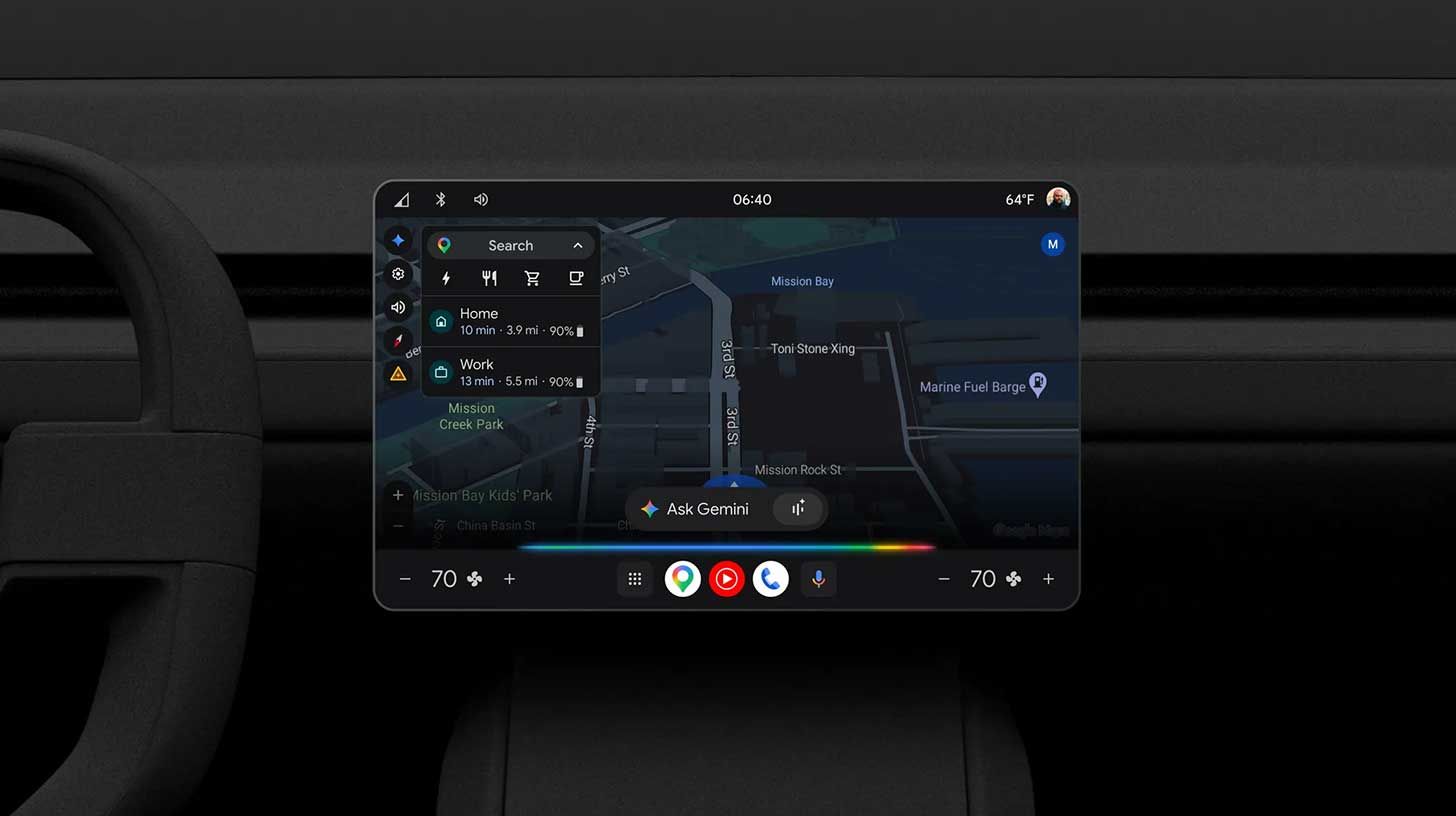
The Rundown: Google is beginning its Gemini upgrade for vehicles with Google built-in, swapping out Assistant for a more conversational system that handles navigation, messages, music, vehicle questions, and hands-free controls across compatible cars.

The details:

  • Drivers can ask for changes to car settings like temperature, control the radio, and pull from Google Maps for customized updates or route planning.

  • A beta Gemini Live mode supports conversations for learning and brainstorming, with Gmail, Calendar, and Home integrations coming later.

  • Gemini can also pull vehicle-specific answers from manufacturer manuals for car assistance and battery status or charging stations for EV cars.

  • The rollout comes to compatible cars in the U.S. first, with General Motors also announcing the feature for ~4M of its vehicles from model year 2022 onward.

Why it matters: One day, AI integrations in cars will be as common as a radio (and eventually the systems will all be driving the cars, too) — but for now, we’re still in the infancy of the rollout. These initial features are fairly basic, but a step on the path towards ‘smart car’ systems of the AI age that provide a serious intelligence upgrade.

AI TRAINING

🤔 Stress test business ideas with Perplexity

The Rundown: In this guide, you will learn how to use Perplexity Deep Research to stress test any business idea. Save the prompt below once and rerun it on every idea you have to see what’s feasible to build.

Step-by-step:

  1. Open Perplexity and switch to Deep Research mode. This works on the free plan (5 queries/day) and is basically a hidden version of Perplexity Computer

  2. Paste this prompt with your idea in the chat, hit run, and walk away for 5 to 6 minutes. Perplexity does the research and builds the slide deck in the same run

  3. Save the prompt somewhere you will actually use it again, like in a dedicated Perplexity space

  4. Then, every Saturday morning, take one idea off your list and run it. You will burn through a year of half-evaluated ideas in a month

Pro tip: Build variants. A 6-slide version for a co-founder pitch, a version that compares two ideas, or a 90-day MVP plan for ideas that already cleared validation.

PRESENTED BY FUEL IX BY TELUS DIGITAL

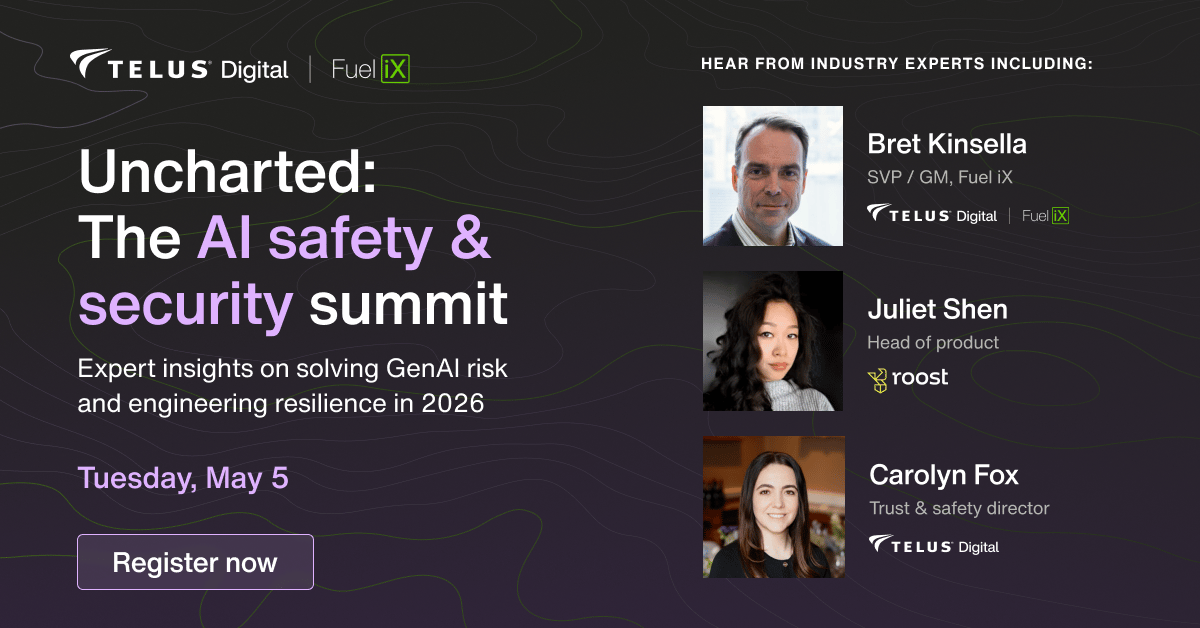
🛡️ Is your AI safety strategy actually working?

The Rundown: Uncharted: The AI safety & security summit unites global leaders to bridge the gap between rapid innovation and production-grade governance. Join Fuel iX on May 5 to move beyond the hype and explore the technical frameworks and proprietary research required to secure the next generation of enterprise GenAI.

Why you should attend:

  • Close the safety gap without slowing technical innovation

  • Learn proven, practical strategies to protect users and secure AI applications

  • Unlock exclusive insights from benchmark safety tests of leading LLMs

Register now.

AI RESEARCH

🧌 OpenAI finds source of ChatGPT’s goblin obsession

Image source: OpenAI

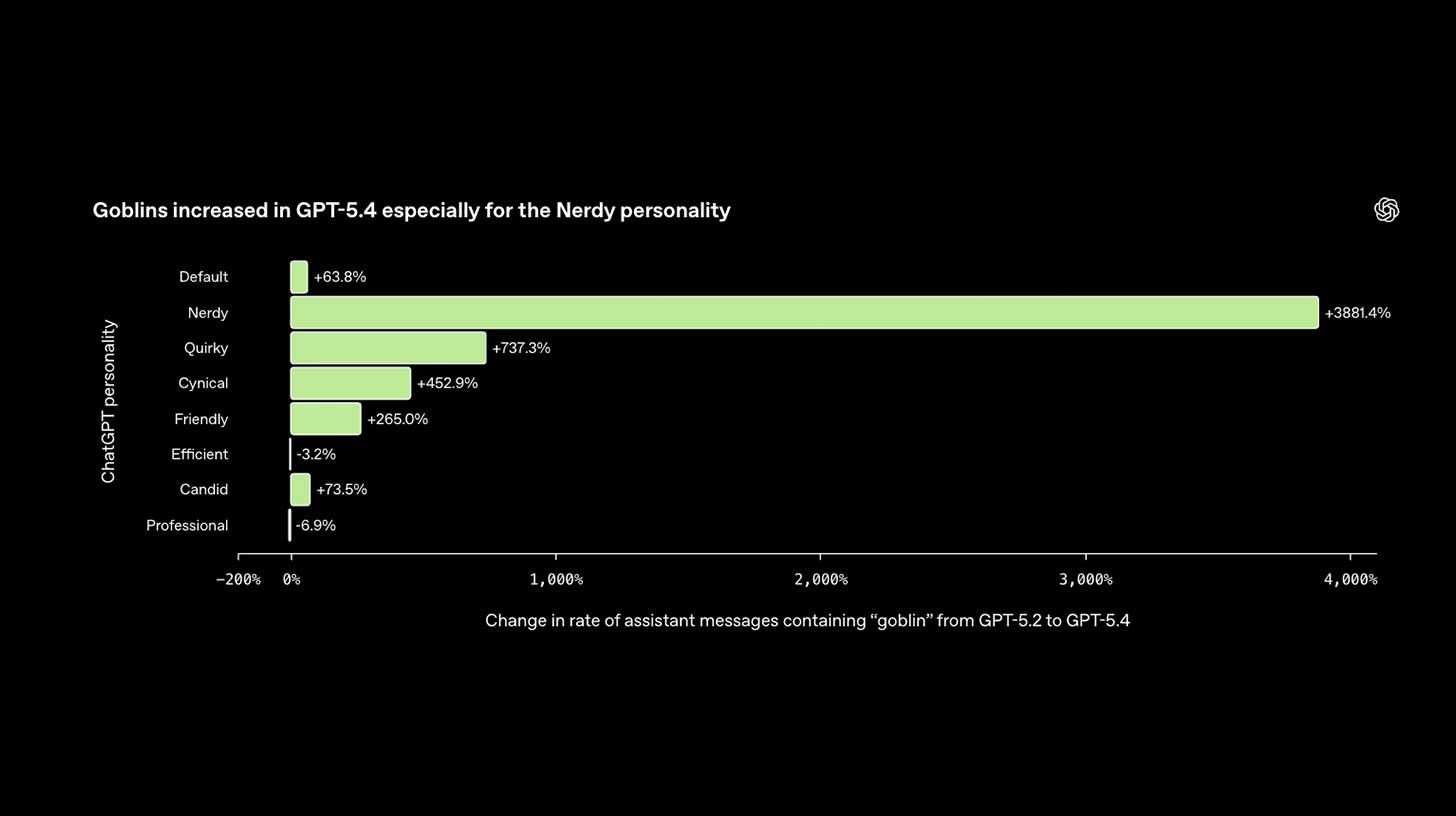
The Rundown: OpenAI just traced ChatGPT’s habit of peppering its responses with goblins, gremlins, and assorted fantasy creatures back to a single reward signal in its ‘Nerdy’ personality, which ended up bleeding into model behavior throughout releases.

The details:

  • After ChatGPT-5.1’s November launch, ‘goblin’ mentions jumped 175% in user conversations, with ‘gremlin’ up 52% and other creatures seeing similar spikes.

  • When OpenAI mapped creature use across personalities, the Nerdy preset lit up, driving two-thirds of all goblin mentions from just 2.5% of traffic.

  • Even users who skipped Nerdy got goblins, with fine-tuning loops recycling the creature-favored outputs back into ChatGPT’s default mode.

  • OpenAI retired Nerdy in March and shipped GPT-5.5 with a Codex prompt specifically banning goblins, gremlins, ogres, trolls, raccoons, and pigeons.

Why it matters: ChatGPT’s goblin-mode is a fun little quirk for your Friday, and another example of how weird LLMs can truly be. A reward in a single personality mode led to a pattern of creature preferences that trickled across chats around the globe. Just like Anthropic’s Golden Gate Claude, we might need a standalone GoblinGPT.

QUICK HITS

🛠️ Trending AI Tools

  • 💳 Link – Stripe’s wallet for AI agents with human approval on every purchase

  • 🔐 Claude Security – Enterprise tool for scanning and patching vulnerabilities

  • 🎨 Imagine Agent – xAI’s agentic canvas in Grok for image and video creation

  • 🤖 Cloud Computer – Manus’s cloud for always-on agents, scrapers, more

📰 Everything else in AI today

Meta opened its ads platform to third-party AI tools via a new MCP server, allowing advertisers to manage campaigns through Claude, Cursor, or any connected agent.

OpenAI announced that it has already surpassed its 2029 Stargate goal of securing 10 GW of compute, with 3 GW added in the last 3 months.

Elon Musk revealed during questioning in his trial vs. OpenAI that xAI has used distillation techniques to train on OpenAI models.

Anthropic launched the public beta for Claude Security, a system that leverages Opus 4.7 to scan codebases for vulnerabilities and help enterprises generate patches.

Cursor released Security Review, which also deploys autonomous agents to check for vulnerabilities and run scheduled codebase scans with results posted to Slack.

COMMUNITY

🤝 Community AI workflows

Every newsletter, we showcase how a reader is using AI to work smarter, save time, or make life easier.

Today’s workflow comes from reader Anonymous:

“Like millions around the globe, I am a recovering addict, more specifically an alcoholic. A lot of literature and studies are available. Some of the core writings go back to the 1930s and have been kept in their original format to preserve their meaning.

The volume of information is amazing and use and nuance is essential to keep the message personal. To help my own journey, I created a notebook in NotebookLM referencing several books produced by Alcoholics Anonymous, clinical research studies, and work by independent authors.

This allows for daily motivational messages, key topics of a particular recovery step, or the clearing up of decisive material with pros and cons. Turning some of these subjects into an audible debate in NotebookLM is a great way to take on differing views and see differences and indeed similarities. It’s also a real go-to for speaking notes, recovery workbooks, and deep research.”

How do you use AI? Tell us here.

🎓 Highlights: News, Guides & Events

  • Read our last AI newsletter: Zuckerberg’s $500M AI biology swing

  • Read our last Tech newsletter: Samsung’s Meta Ray-Ban rival just leaked

  • Read our last Robotics newsletter: A humanoid baggage handler has landed

  • Today’s AI tool guide: Stress test business ideas with Perplexity

See you soon,

Rowan, Joey, Zach, Shubham, and Jennifer — the humans behind The Rundown

Zuckerberg’s $500M AI biology swing

Read Online | Sign Up | Advertise

Good morning, {{ first_name | AI enthusiasts }}. Google Deepmind’s Demis Hassabis has predicted that AI could eventually end disease, and Mark Zuckerberg and Priscilla Chan’s Biohub just put $500M on the same bet.

Their new five-year Virtual Biology Initiative pairs major funding and a powerhouse of partners, all coordinated around the same goal: producing enough data to push AI to model how disease starts at the cell level.

Reminder: Our next live workshop is today at 2 PM EST! Join for a walkthrough of OpenAI’s Codex platform, its new features, and how to best leverage it as a non-technical user. RSVP here.


In today’s AI rundown:

  • Zuckerberg’s Biohub funnels $500M into AI biology

  • Mayo Clinic AI spots pancreatic cancer 3 years early

  • Build a custom blog writing agent with no code

  • Food AI’s ‘ChatGPT moment’ — tastes like a chef

  • 4 new AI tools, community workflows, and more

LATEST DEVELOPMENTS

BIOHUB

🧬 Zuckerberg’s Biohub funnels $500M into AI biology

Image source: Images 2.0 / The Rundown

The Rundown: Biohub, the nonprofit backed by Mark Zuckerberg and Priscilla Chan’s CZI, announced a $500M Virtual Biology Initiative to build open datasets and models that can predict how human cells behave — pushing AI toward biology simulation.

The details:

  • $400M of the $500M will fund data generation and imaging tech, with $100M for external research labs and research efforts.

  • Nvidia, Allen Institute, Arc, and others are joining the initiative, with Biohub committing to open datasets as a shared base for AI biology research.

  • Current AI biology datasets max out near 1B cells, with Biohub’s Alex Rives saying an “order of magnitude” more data is needed to accelerate the efforts.

  • The goal is to train models on the data to use AI toward “understanding disease and reprogramming it at the level of cells, molecules, and tissues.”

Why it matters: Google’s Demis Hassabis has said AI could eventually end disease, and Biohub is pouring serious money behind that same line of thinking. The question is whether the scaling that cracked language and protein structure also holds for cells, and whether $500M gets anywhere close to the data scale needed to find out.

TOGETHER WITH GLEAN

📈 From agent sprawl to real ROI

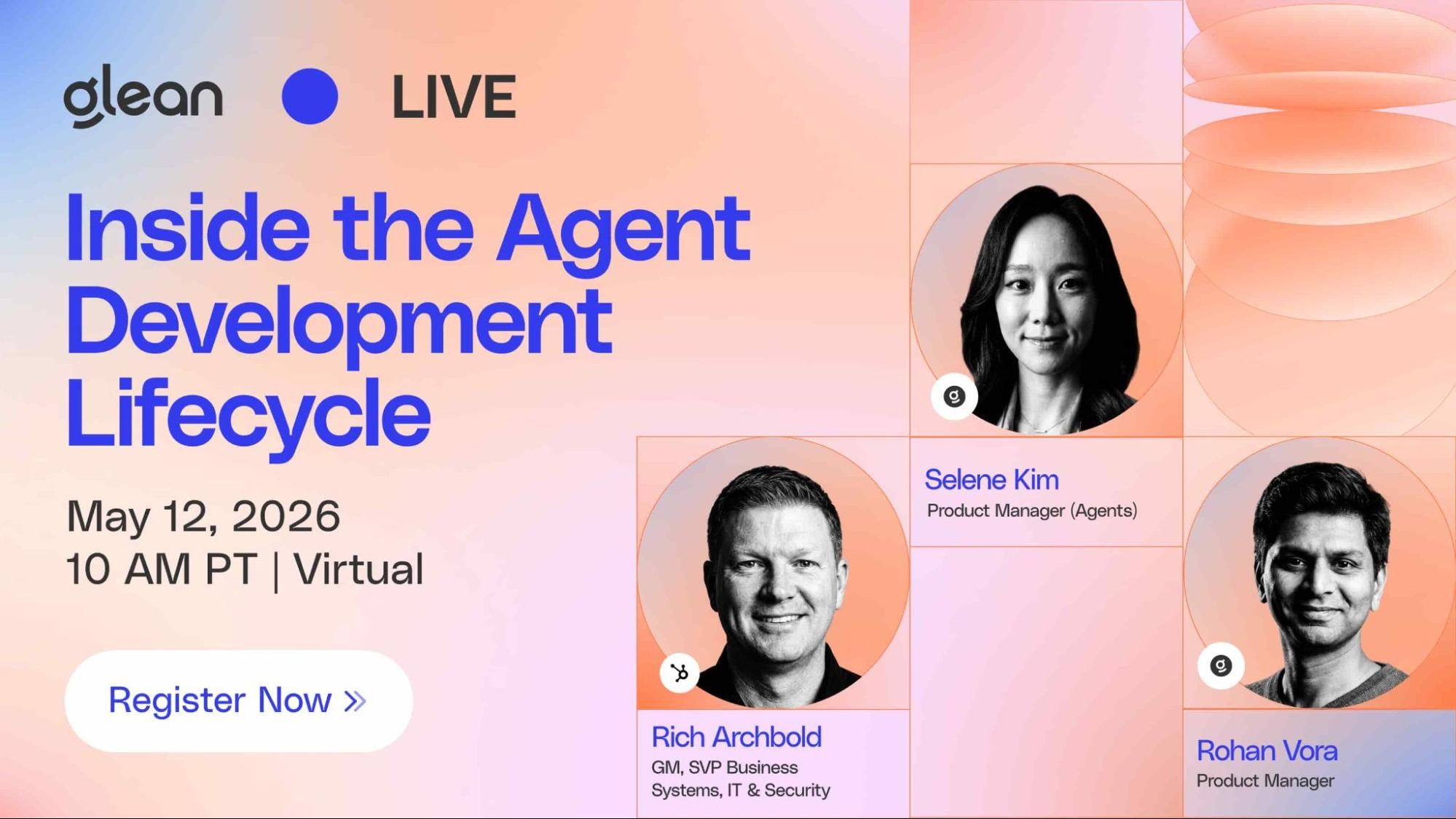
The Rundown: Organizations are deploying agents across functions, but few are seeing the ROI they expected. Join Glean:LIVE on May 12 to discover the Enterprise Agent Development Lifecycle — a new operating model that moves enterprises from scattered experiments to agents that deliver real, measurable impact.

Register for Glean:LIVE to:

  • Get a repeatable framework for building, launching, and governing agents at scale

  • Hear from enterprise leaders on the decisions shaping their agent strategy

  • Watch product demos spanning the full agent lifecycle — with a live Q&A at the end

Register now.

AI & HEALTHCARE

🔬 Mayo Clinic AI spots pancreatic cancer 3 years early

Image source: Mayo Clinic

The Rundown: Mayo Clinic published new data on REDMOD, an AI that reads invisible tissue patterns on standard CT scans, catching pancreatic cancer up to three years ahead of when doctors typically find it and nearly doubling specialist accuracy.

The details:

  • REDMOD reviewed nearly 2,000 routine CT scans that specialists had originally read as normal before later diagnoses, picking up 73% of the cases early.

  • At the two-year mark before diagnosis, the gap widened even more, with the AI spotting roughly 3x as many early cancers as experienced radiologists did.

  • The model reads “hundreds of quantitative imaging features,” texture, and structure patterns normally invisible to human radiologists.

Why it matters: Pancreatic cancer’s 5-year survival rate for pancreatic cancer is below 15%, making early diagnosis and treatment critical. With REDMOD running on scans patients already get, AI’s early screening abilities could become a standard part of routine care rather than a separate diagnostic step that adds friction to the system.

AI TRAINING

✍️ Build a custom blog writing agent with no code

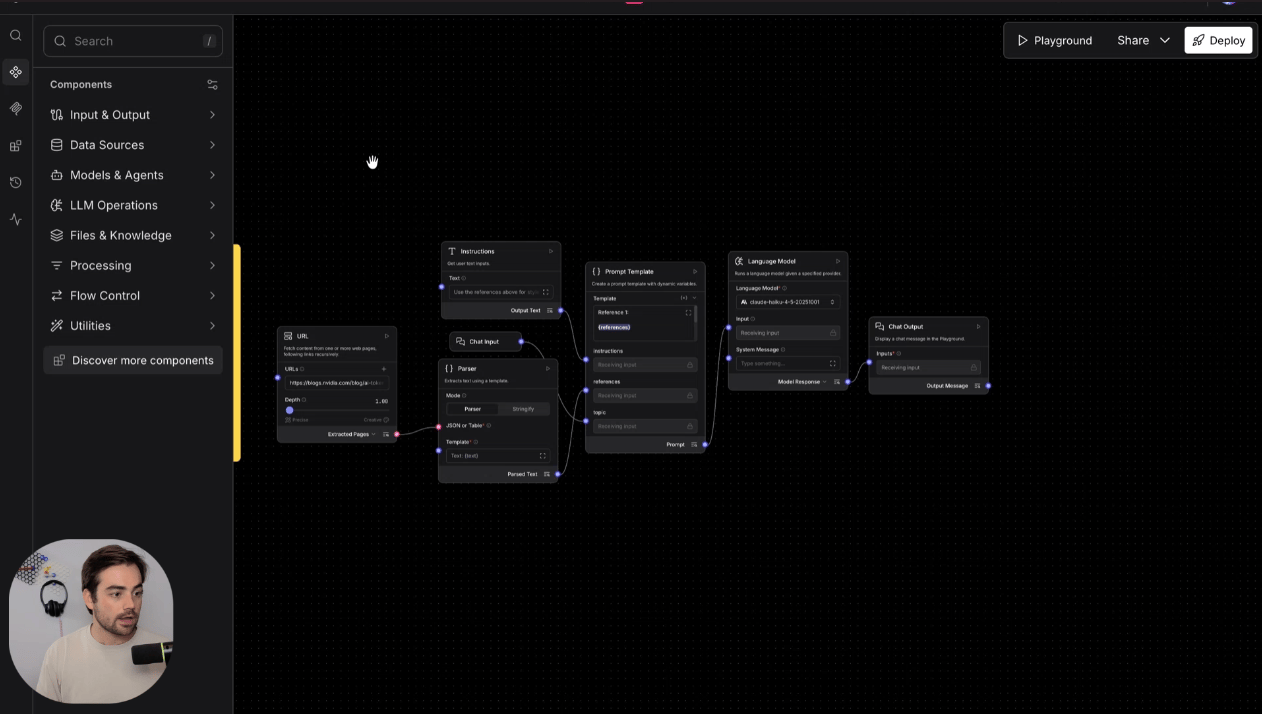
The Rundown: In this guide, you will learn how to build a subagent in Langflow that writes blog posts in your website’s style. The big win is that the agent runs locally for free (besides LLM calls) and can be triggered by Claude, Codex, etc.

Step-by-step:

  1. Download Langflow, open it on your computer (it runs locally), click New Flow, go to the content generation section, and choose the Blog Writer template

  2. Add a text input called “topic”, giving the agent a topic to write about, and link your best blog in the reference input so the agent can copy your writing style

  3. Add your OpenAI or Anthropic API key under the language model settings. Then select the model you want the flow to use

  4. Click on Playground and test it with a topic. That runs the flow, pulls in your reference style, and gives you a first draft

Pro tip: If you want Claude to use this as a subagent, click Share > MCP Server > Claude MCP. Then Claude can call that blog-writing tool for you whenever you need it.

PRESENTED BY BOX

🧠 Turn enterprise knowledge into AI action

The Rundown: Enterprise AI only works when it has the right business content. Box is the secure, essential context layer for agents to access the institutional knowledge that makes a company run.

Box’s AI suite includes:

  • Box Extract to pull actionable data from enterprise content at scale

  • Box Agent to transform unstructured data into the context AI needs

  • Box Automate (now GA) to orchestrate agentic workflow automation

Learn more about Box’s AI solutions at Box’s Content + AI Virtual Summit on May 20.

AI RESEARCH

🧑‍🍳 Food AI’s ‘ChatGPT moment’ — tastes like a chef

Image source: Midjourney

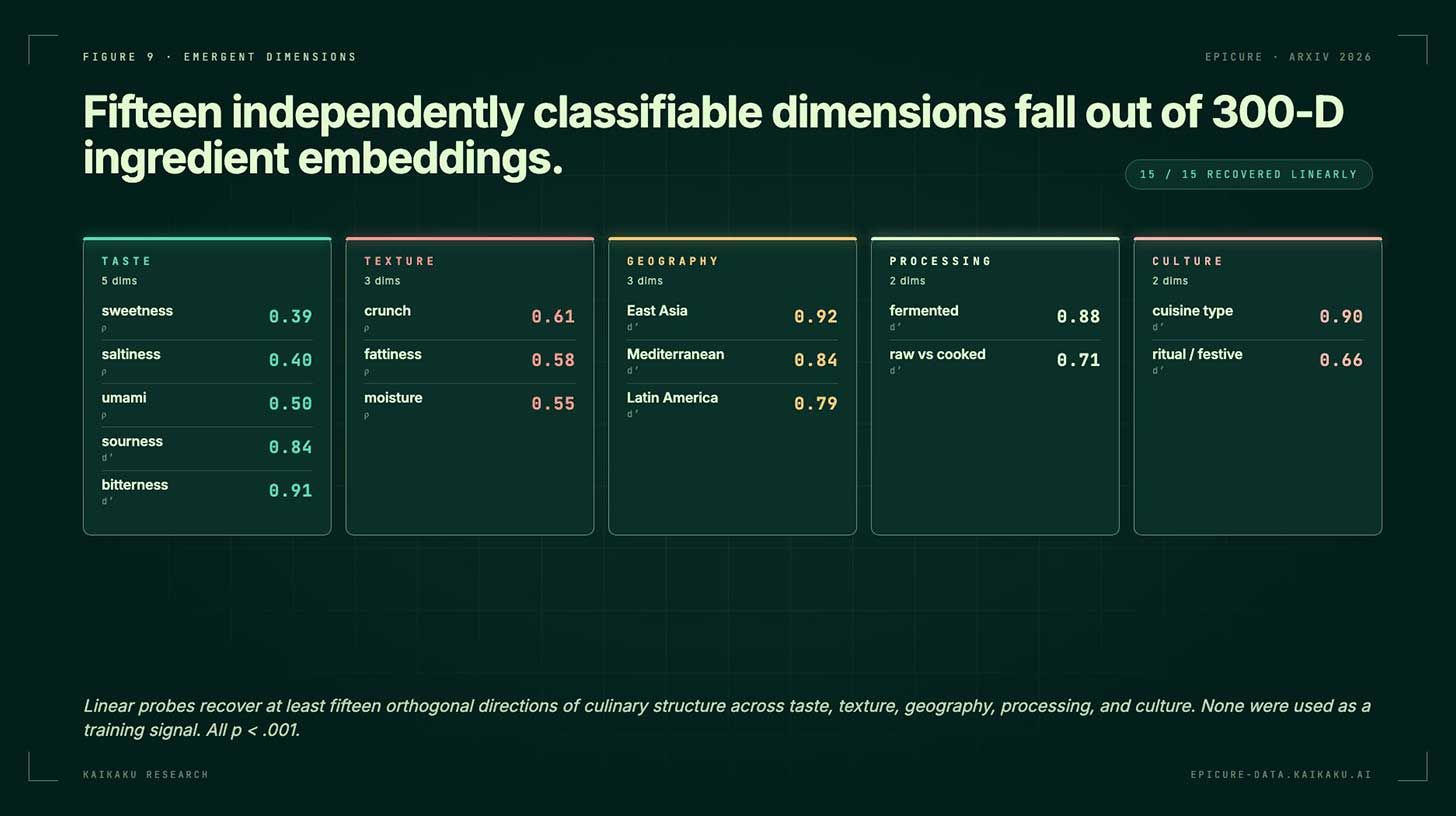
The Rundown: Food robotics startup KAIKAKU AI just published Epicure, a new paper claiming a “ChatGPT moment” for food AI that shows its AI model can pick up on flavor, cuisine, and texture just from how chefs combine ingredients in recipes.

The details:

  • Researchers cleaned 6,653 messy ingredient entries into 1,032 usable foods, then mapped with AI how they relate across recipes.

  • Despite never seeing chemistry data or taste labels, the model identified all 5 basic tastes, ordered peppers by spiciness, and tagged cuisines by region.

  • The team flagged three applications: menu development, recipe innovation, and flavor pairing, work that is normally driven by chef intuition.

  • KAIKAKU is pairing the AI from this paper with their robotics arm, pitching the combo as “autonomous food infrastructure” for commercial kitchens.

Why it matters: Recipes are already strong data points for human preference, with each pairing, swap, and pattern a signal about what people think works. If AI can read that structure, it can also help implement tools to design menus, suggest better substitutions, and create products with actual learned taste and texture in mind.

QUICK HITS

🛠️ Trending AI Tools

  • 🎶 ElevenMusic – Platform for AI song generation, remixing, creator payouts

  • 🚀 MiMo-V2.5-Pro – Xiaomi’s powerful new open-source model

  • 🧠 GPT 5.5 – OpenAI’s frontier model for agentic coding and computer use

  • ⚙️ Cursor SDK – Run Cursor’s coding agents in other workflows and products

📰 Everything else in AI today

ElevenLabs launched ElevenMusic, a streaming platform with built-in AI remixing and AI-assisted track creation, already hosting 4k+ artists and offering creator payouts.

Two U.S. House committees opened probes into Cursor-maker Anysphere and Airbnb over Chinese AI use, with Composer 2 built on Kimi and Airbnb’s agent on Qwen.

Mistral AI launched Vibe remote agents, cloud sessions that run coding tasks in parallel, powered by the company’s new open-weights Medium 3.5 model.

Google added file creation into Gemini, allowing the model to output formats like Google Docs, Sheets, and Slides, Microsoft Word and Excel files, Markdown, and more.

OpenAI released a Cybersecurity Action Plan to “democratize” AI cyber defense and work with the U.S. government and industry on threat coordination and defender tools.

COMMUNITY

🤝 Community AI workflows

Every newsletter, we showcase how a reader is using AI to work smarter, save time, or make life easier.

Today’s workflow comes from reader Patrick B. in Boonsboro, MD:

“A couple of months ago, I received a cancer diagnosis… The amount of appointments, trying to understand the medical concepts, my diagnosis, appointments, scans, and how cancer really operates, is really overwhelming.

I built out several assets and artifacts in Claude, including a dashboard to help me manage my diagnosis with appointments, insurance claims, scans, treatment, regimens, etc. This allowed me to also share with my family the progress and what was happening with my diagnosis. As far as being a patient advocate, this really made it a lot easier for me to ask better, more targeted questions to my oncology team and helped me manage this whole process a lot better than I could have otherwise.

This has been a huge advantage for me in keeping on top of my diagnosis and making sure that I follow the doctor’s instructions in a more detailed way. It also gives me a central place to ask questions about my diagnosis since it knows me like my doctors.”

How do you use AI? Tell us here.

🎓 Highlights: News, Guides & Events

  • Read our last AI newsletter: The biggest AI trial ever kicks off

  • Read our last Tech newsletter: Samsung’s Meta Ray-Ban rival just leaked

  • Read our last Robotics newsletter: The Chinese robot ban is coming

  • Today’s AI tool guide: Build a custom blog writing agent with no code

  • RSVP to workshop today @ 2PM EST: Codex for non-technical operators

See you soon,

Rowan, Joey, Zach, Shubham, and Jennifer — the humans behind The Rundown

The biggest AI trial ever kicks off

Read Online | Sign Up | Advertise

Good morning, {{ first_name | AI enthusiasts }}. The two faces behind AI’s biggest rivalry are finally in the same room — but this time it’s a federal courtroom, with Elon Musk on the witness stand and Sam Altman watching from the gallery.

Musk’s $130B trial against OpenAI kicked off on Tuesday, with four weeks of testimony, hundreds of pages of private emails set to spill into the public record, major AI names on the stand, and a lot more drama still to come.


In today’s AI rundown:

  • Elon Musk’s $130B trial against OpenAI kicks off

  • Google finalizes Pentagon deal despite protests

  • Automate any manual task with Codex

  • Talkie is an AI that thinks it’s 1930

  • 4 new AI tools, community workflows, and more

LATEST DEVELOPMENTS

OPENAI

🏛️ Elon Musk’s $130B trial against OpenAI kicks off

Image source: Images 2.0 / The Rundown

The Rundown: Elon Musk just took the stand in federal court as opening statements began in his $130B lawsuit against OpenAI, accusing CEO Sam Altman of “stealing a charity” — while OAI’s lawyer told the jury Musk sued because he “didn’t get his way.”

The details:

  • Musk’s suit seeks $130B in damages, the ouster of Altman and Brockman from the board, and a forced unwind of OpenAI’s recent for-profit conversion.

  • Musk said in his testimony that “if a verdict comes out that it’s OK to loot a charity, the entire foundation of charitable giving in America will be damaged”.

  • OAI’s legal team called Musk’s suit “sour grapes,” saying Musk didn’t like the success the company saw after his departure.

  • Microsoft’s legal team said Musk didn’t object to OAI’s structure until after its success as xAI’s competitor, and said it “knew nothing” of Altman’s 2023 firing.

Why it matters: This is just Day 1 of one of the most contentious court cases the tech world has seen, and the details are going to be juicy. With high-profile AI characters set to testify and with hundreds of pages of private messages about to spill into the public record, the next four weeks are going to be hard to look away from.

TOGETHER WITH TELEPORT

🛡️ Trusted ephemeral runtime for infra agents

The Rundown Running agents in production shouldn’t mean trading security for speed. Teleport Beams provisions an isolated VM and assigns identity via a short-lived certificate before an agent runs a single line — zero secrets, no IAM wrestling, no standing privileges.

Built for teams shipping real agents:

  • Each Beam runs in an isolated Firecracker VM

  • Supports coding agents, sandboxed apps, and agentic jobs

  • Fully auditable, with identity and access tied to every session

Explore Beams.

GOOGLE

🪖 Google finalizes Pentagon deal despite protests

Image source: Images 2.0 / The Rundown

The Rundown: Google signed a classified AI deal with the Pentagon, opening its models to “any lawful government purpose,” the same week that 600+ staffers wrote an open letter to CEO Sundar Pichai, calling to reject the use of AI for military purposes.

The details:

  • More than 600 Google employees sent Pichai a letter on Monday asking him to “refuse to make our AI systems available for classified workloads.”

  • The Information reported that the contract opens Google’s AI to “any lawful government purpose”, with no legal right to veto how the Pentagon uses it.

  • OAI and xAI inked deals with the Pentagon last month, with Anthropic currently fighting in court after being blacklisted for not dropping its guardrails.

  • Google’s no-weapons pledge was scrubbed from its AI principles in 2025, after it was implemented in 2018 following successful staff protests.

Why it matters: The Pentagon drama might still feel fresh in the OAI-vs-Anthropic rivalry, but it’s not discouraging another top AI lab from making a similar deal. Google’s now wading into a messy territory from a PR and internal perspective, and time will tell if the same backlash we saw with ChatGPT now comes to Gemini’s doorstep.

AI TRAINING

✅ Automate any manual task with Codex

The Rundown: In this guide, you will learn how to let OpenAI’s Codex click through any annoying, repetitive work using Computer Use on Mac or Windows.

Step-by-step:

  1. Open Codex, go to Plugins, find and enable the Computer Use plugin, and then start a new task

  2. Open the permissions menu and switch from Default permissions to Full access. Confirm any prompts

  3. Give a real task, like: “Open Chrome and debug the UI of this web page http://localhost:3000/. Click through, reproduce the bug I describe, then tell me what you think is causing it. If not sure, ask before making changes”

Pro tip: Codex can automate repetitive workflows in local apps, too. Try it for Photoshop exports, Premiere cleanup, file renaming, or any other tool.

PRESENTED BY TELY AI

💬 Market leaders get leads from ChatGPT and Google

The Rundown: Your buyers are asking AI questions — and AI is answering with your competitors, not you. Tely makes AI like ChatGPT, Google, and Claude recommend your business instead.

With Tely AI, you can:

  • Get recommended in ChatGPT, Google, Perplexity, and Claude in as little as 1 week

  • Fully hands-off: no writers, no agencies, no managing content

  • Costs less than hiring freelancers or maintaining a marketing team

  • Ideal for niche industries where expertise matters

Get leads from Google and ChatGPT on autopilot.

AI RESEARCH

🕰️ Talkie is an AI that thinks it’s 1930

Image source: Images 2.0 / The Rundown

The Rundown: Researchers Nick Levine, David Duvenaud (fmr. Anthropic), and Alec Radford (fmr. OpenAI) demoed Talkie, a 13B ‘vintage’ AI model trained only on text from before 1931, built to test how AI thinks when its worldview predates the internet.

The details:

  • Talkie was trained on 260B tokens of pre-1931 books, newspapers, journals, patents, and case law, all now in the US public domain.

  • To teach talkie to chat without modern data, the team pulled instructions from etiquette manuals and cookbooks, with Claude Sonnet 4.6 grading the answers.

  • The coding language Python didn’t exist in 1930, but Talkie wrote working code by flipping a plus sign to a minus sign in an example, proving it can generalize.

  • AI benchmarks get poisoned when models train on their own test data — talkie sidesteps that, with a GPT-3-level version coming next.

Why it matters: Today’s frontier models all sound vaguely similar because they all read roughly the same modern web. Talkie is definitely cut from a different cloth — but the Python coding anecdote is a fascinating part of the experiment that shows what kind of learning and reasoning is potentially going on beneath the original training data.

QUICK HITS

🛠️ Trending AI Tools

  • 📊 Replit Slides – Create polished, stunning slides in seconds with AI

  • 🤖 Nemotron 3 Nano Omni – NVIDIA’s open AI combining vision, audio, text

  • 🌎 Echo-2 – SpAItial’s new SOTA text-to-3D world model

  • ⚙️ Workflows – Mistral’s enterprise tool for chaining AI agents

📰 Everything else in AI today

OpenAI announced that GPT-5.5, Codex, and Managed Agents are now available via Amazon Bedrock, coming a day after its new contract restructure with Microsoft.

NVIDIA released Nemotron 3 Nano Omni, a new open model that can handle vision, audio, and text at 9x the speed of rival open multimodal models.

The WSJ reported that OAI fell short of its targets for revenue and user growth, with CFO Sarah Friar questioning its massive spending — with OAI calling it “ludicrous.”

Anthropic added new connectors for a broader range of creative workflows, including apps like Blender, Adobe Creative Cloud, Autodesk Fusion, SketchUp, and more.

Xiaomi open-sourced MiMo-V2.5-Pro, which ties Kimi K2.6 on Artificial Analysis’ leaderboard, featuring a 1M context window and strong efficiency for agentic tasks.

SpAItial launched Echo-2, a new SOTA world model that turns text or photos into explorable 3D worlds, claiming to beat World Labs’ Marble 1.1 across benchmarks.

COMMUNITY

🤝 Community AI workflows

Every newsletter, we showcase how a reader is using AI to work smarter, save time, or make life easier.

Today’s workflow comes from reader Alan C. in Ontario, Canada:

“I used AI to resolve what looked like a furnace failure during a cold night without calling a technician. After installing a Google Nest Thermostat about a year ago, my system started making a loud ‘revving’ noise and flashing error codes (2 and 7) that pointed to pressure switch or hardware faults.

I photographed the control board and wiring and uploaded them to Google Gemini. It identified the furnace, traced the issue to thermostat power stealing, and flagged a wiring phasing error. It then guided a simple ‘G-to-C’ wire conversion to provide stable power, along with steps to clear lockouts and verify readings.

Within an hour, the noise stopped, error codes cleared, and the system stabilized to normal operation. It saved me about $300 HVAC tech service call, and I avoided a night in the cold.”

How do you use AI? Tell us here.

🎓 Highlights: News, Guides & Events

  • Read our last AI newsletter: OpenAI and Microsoft’s new open relationship

  • Read our last Tech newsletter: Samsung’s Meta Ray-Ban rival just leaked

  • Read our last Robotics newsletter: The Chinese robot ban is coming

  • Today’s AI tool guide: Automate any manual task with Codex

  • RSVP to workshop Thursday @ 2PM EST: Codex for non-technical operators

See you soon,

Rowan, Joey, Zach, Shubham, and Jennifer — the humans behind The Rundown

OpenAI and Microsoft’s new open relationship

Read Online | Sign Up | Advertise

Good morning, {{ first_name | AI enthusiasts }}. The Microsoft-OpenAI relationship is no longer an exclusive marriage… But it’s also not exactly a breakup either.

The new deal terms allow OpenAI to date around in the cloud (hello, Amazon), while Microsoft keeps the awkward-but-lucrative role of ex with benefits: less control, but still very much getting paid.

P.S. — We’re hiring for five new roles at The Rundown to continue scaling our mission to help 1B+ people turn AI into a superpower. Check out the available roles here and earn a $2,000 referral bonus if you help us hire someone full-time.


In today’s AI rundown:

  • OpenAI rewrites Microsoft deal, removes AGI clause

  • Beijing blocks Meta’s $2B Manus deal

  • Set up AI teammates with ChatGPT Workspace Agents

  • AlphaGo creator’s new $1.1B ‘superlearner’ lab

  • 4 new AI tools, community workflows, and more

LATEST DEVELOPMENTS

OPENAI & MICROSOFT

📜 OpenAI rewrites Microsoft deal, removes AGI clause

Image source: Images 2.0 / The Rundown

The Rundown: OpenAI and Microsoft reworked their partnership terms, ending Microsoft’s exclusivity over OAI’s IP, killing the AGI clause, and freeing OpenAI to ship products on any cloud while Microsoft keeps a revenue share through 2030.

The details:

  • OAI can now utilize rival clouds like Amazon Bedrock, with Microsoft still remaining a main cloud partner with Azure-first launch access through 2032.

  • The agreement settles Microsoft’s reported lawsuit threat over the $50B Amazon-OpenAI deal that gave AWS exclusive rights to OAI’s Frontier platform.

  • Amazon CEO Andy Jassy called the announcement “very interesting”, coming after OpenAI CRO Denise Dresser’s memo talking up its Bedrock platform.

  • Microsoft will stop paying revenue share to OAI, with both companies’ obligations now running on calendar dates instead of an AGI announcement.

Why it matters: It’s no secret that this relationship has gone sour, and these changes remove the exclusivity that Dresser said “limited” OpenAI’s ability to meet enterprises where they were. The AI giant now gets to date around in the cloud, while Microsoft locks in a six-year revenue stream without an ambiguous AGI clause hanging over it.

TOGETHER WITH YOU.COM

📈 Do you know how to evaluate your web search APIs?

The Rundown: Teams often pick a web search provider by running a few test queries and hoping for the best—a recipe for hallucinations and unpredictable failures. This technical guide from You.com gives you access to an exact framework to evaluate web search APIs.

What you’ll get:

  • A four-phase framework for evaluating AI search

  • How to build a golden set of queries that predicts real-world performance

  • Metrics and code for measuring accuracy

Go from “looks good” to proven quality. Learn how to run an eval.

META & MANUS

🚫 Beijing blocks Meta’s $2B Manus deal

Image source: Images 2.0 / The Rundown

The Rundown: China vetoed Meta’s $2B Manus acquisition and told the companies to withdraw the AI startup deal, turning a Singapore-based company with Chinese roots into a warning shot for founders trying to move talent and tech outside Beijing’s reach.

The details:

  • Meta announced the $2B deal in December, with Chinese officials opening a January probe into export-control and foreign-investment rules.

  • China’s National Development and Reform Commission said it would bar foreign investment in Manus, directing Meta and the startup to undo the deal.

  • Meta said the two teams were already “deeply integrated” at its Singapore office, and Manus’s site already read “now part of Meta.”

  • The order lands weeks before Trump’s planned May meeting with Xi in Beijing, with Manus executives reportedly barred from leaving China during the probe.

Why it matters: Beijing just made AI talent a national security asset, applying to startups the same type of export-control logic the U.S. uses on chips. With the two already intertwined and Meta saying “the transaction complied fully with applicable law”, it’s unclear how an unwind will even work — or if the tech giant will comply.

AI TRAINING

🤖 Set up AI teammates with ChatGPT Workspace Agents

The Rundown: In this guide, you will learn how to set up AI teammates that are actually useful using ChatGPT’s new Workspace Agents tool (currently in research preview for Business, Enterprise, Edu, and Teachers plans).

Step-by-step:

  1. Go to chatgpt.com/agents, click Create agent, and pick a tool, database, or process for this agent to “own”.

  2. Prompt: “Create an agent that manages [lead pipeline, Google Docs folder, Notion database, etc.]. It should do 3 main tasks that can run autonomously on schedules to save me time.”

  3. Follow the setup prompts to add integrations and define what the agent should touch. Codex will look around your integrations to best set up the agent.

  4. Return to the Agents page, select your new agent, and try each of the main tasks. You can click the Schedule button to have the agent run every day.

Pro tip: If you don’t have a ChatGPT business plan, don’t worry. You can still use this prompt + approach in other tools to create helpful agents.

PRESENTED BY HEAR.COM

👂 The AI in your ear you haven’t heard of

The Rundown: Horizon IX by hear.com uses MultiBeam AI to identify individual speakers and shift microphone focus in real time — automatically adapting to any environment without a single manual adjustment.

With Horizon IX, you’ll:

  • Hear what 10,000 scans per second actually sounds like

  • Track individual speakers as conversations shift — zero manual tuning

  • Adapt instantly across any environment, from a packed conference room to a busy street

This is what it sounds like when the hardware finally catches up in AI. Put Horizon IX to the test.

INEFFABLE INTELLIGENCE

🧠 AlphaGo creator’s new $1.1B ‘superlearner’ lab

Image source: Ineffable Intelligence

The Rundown: Ex-DeepMind researcher David Silver launched Ineffable Intelligence, a London lab that raised $1.1B at a $5.1B valuation to build an AI that learns from experience instead of training data, to “make first contact with superintelligence”.

The details:

  • Silver led DeepMind’s reinforcement learning team for a decade, building acclaimed models AlphaGo, AlphaZero, AlphaStar, and AlphaProof.

  • Ineffable’s models skip pre-training and human data, letting agents learn from experience in simulations — creating what Silver calls a “superlearner.”

  • Silver framed human data as “a kind of fossil fuel” and his approach as “a renewable fuel, a model that can just learn and learn and learn forever.”

  • The $1.1B is Europe’s largest seed ever, with Ineffable claiming success would “represent a scientific breakthrough of comparable magnitude to Darwin.”

Why it matters: Yann Lecun’s theory that LLMs are a dead end has gotten some powerful companies, with AMI Labs, Recursive Superintelligence, and now Ineffable ($1.1B) all raising on variations of the view. Silver’s track record speaks for itself, and the more brilliant minds taking different paths towards AGI, the better.

QUICK HITS

🛠️ Trending AI Tools

  • 🎨 Firefly AI Assistant – Adobe’s AI agent for multi-app Creative Cloud work

  • 🎥 Kling 3.0 – New 4K mode for generating AI videos with cinematic quality

  • 📽️ HappyHorse – Alibaba’s new SOTA video generation model

  • ❤️ Lovable – AI app building platform, now available via mobile app

📰 Everything else in AI today

Uncharted: The AI safety & security summit, May 5 – learn how to operationalize AI safety and close the AI security gap with proven enterprise strategies. Register for free.*

The trial between Elon Musk and OpenAI kicked off on Monday with the start of jury selection, with the two sides trading barbs on X ahead of opening statements.

Tech analyst Ming-Chi Kuo said OpenAI is working on its own smartphone alongside MediaTek and Qualcomm, with native AI agents and production likely in 2028.

Adobe opened access to its new Firefly AI Assistant in public beta, letting creators prompt multi-app Creative Cloud workflows while keeping outputs editable.

Alibaba’s new Happy Horse video model rolled out across video platforms, with the release taking the top spot on Artificial Analysis’s video leaderboard.

Taylor Swift filed three federal trademarks for her likeness and voice, joining actor Matthew McConaughey in taking legal action to fight and prevent AI deepfakes.

*Sponsored Listing

COMMUNITY

🤝 Community AI workflows

Every newsletter, we showcase how a reader is using AI to work smarter, save time, or make life easier.

Today’s workflow comes from reader Lydia F. in North Liberty, Iowa:

“I used Codex to build a web-based application to help my teenage daughter study for the Iowa Driver’s Permit knowledge test. I uploaded the full test study manual from the Department of Transportation and a couple of practice tests, then built a bank of 200 flashcards and a quiz feature that pulls 25 questions from a bank of 200 multiple-choice and True/False questions (with the most common topics weighted to appear more frequently).

I shared the URL with other moms of teens in my town. Now that studying for the driver’s test is so easy, our teens have no excuse!”

How do you use AI? Tell us here.

🎓 Highlights: News, Guides & Events

  • Read our last AI newsletter: DeepSeek resurfaces with cheap, capable V4

  • Read our last Tech newsletter: Big Tech’s $20B lobbying blitz

  • Read our last Robotics newsletter: The Chinese robot ban is coming

  • Today’s AI tool guide: Set up AI teammates with Workspace Agents

  • RSVP to workshop Thursday @ 2PM EST: Codex for non-technical operators

See you soon,

Rowan, Joey, Zach, Shubham, and Jennifer — the humans behind The Rundown