


Insider Brief
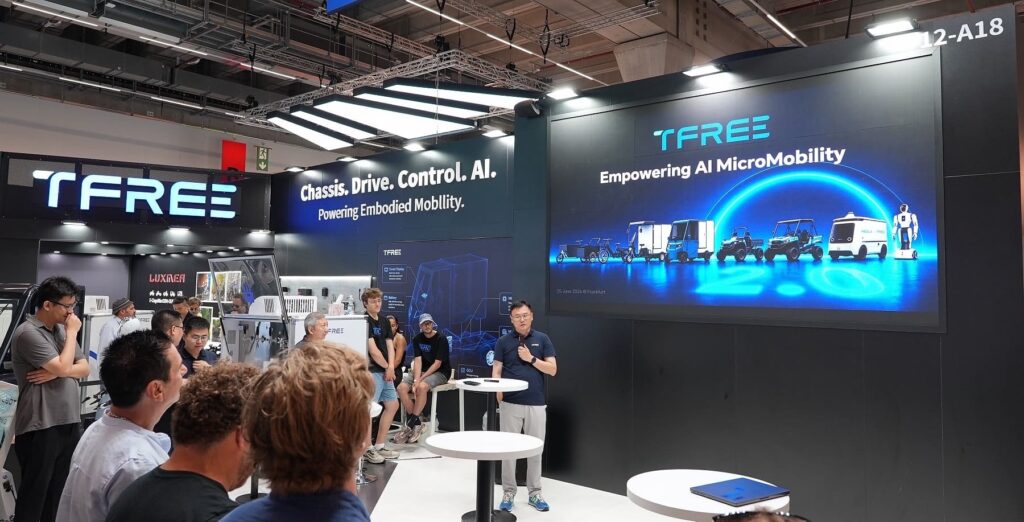
- TFREE unveiled a global strategy at EUROBIKE 2026 to turn low-speed electric vehicles into connected, software-run systems for delivery, micromobility and robotics.
- The company’s “AI Micro Mobility 2.0” platform is built on Luxmea’s manufacturing background and combines a universal chassis platform, intelligent vehicle control and software services for light commercial vehicles, autonomous delivery platforms and robotics applications.
- TFREE said the platform includes 4G connectivity, over-the-air updates, AI-based predictive maintenance and open APIs, with pilot projects underway in Germany and Belgium.
TFREE unveiled a strategy at EUROBIKE 2026 to build software, vehicle-control and chassis systems for low-speed electric vehicles used in delivery, micromobility and robotics.
The company introduced what it calls “AI Micro Mobility 2.0,” a platform strategy designed to move the sector beyond managing individual vehicles and toward coordinating fleets, infrastructure and applications through software.
TFREE said the approach is built on parent company Luxmea’s manufacturing background and combines commercial chassis engineering, vehicle-control systems and cloud-based software. The platform is intended to serve two-wheel, three-wheel and four-wheel light commercial vehicles, as well as autonomous delivery vehicles and robotics applications.
According to Luxmea, the company has delivered more than 400,000 electric bicycles compliant with the EN 15194 standard and more than 150,000 commercial cargo vehicles compliant with EN 17860 and DIN EN 17860 standards.
What is AI Micro Mobility 2.0?
The TFREE platform is organized around three main areas: a universal chassis platform, intelligent vehicle control and software and ecosystem services. The company said the system uses a software-defined vehicle architecture, meaning core functions can be managed and updated through software rather than fixed hardware alone.
TFREE said the platform includes 4G internet connectivity, over-the-air software updates, AI-based predictive maintenance and open application programming interfaces, or APIs, that allow other systems to connect with the platform. Those tools are intended to help coordinate vehicles, fleets, charging or energy systems, infrastructure and operating scenarios.
Collaborations
The company is also building an AI partner network for low-speed transportation. Its partners include Yancheng CAS-HT Computing Research Institute Co. Ltd., autonomous delivery vehicle company Neolix and embodied AI robotics company Galbot.
Through those collaborations, TFREE said it is exploring uses for high-performance computing, digital twins, unmanned delivery and robotics in low-speed transport settings. Digital twins are software models of physical systems that can be used to test or manage operations.
TFREE has started pilot projects in Europe with Bonn-based VEMO in Germany and Stalem in Belgium. The projects are intended to test intelligent fleet operations, digital energy replenishment and micromobility applications based on the company’s Universal Chassis Platform.
The company said the platform was engineered to comply with European data, safety and product standards, including GDPR, CE, ISO, the EU Battery Passport and DIN EN 17860.
Image credit: TFREE