

Insider Brief
- American Rheinmetall received an 18-month U.S. Army contract to develop hybrid-powered autonomous ground vehicles for transporting supplies in contested environments.
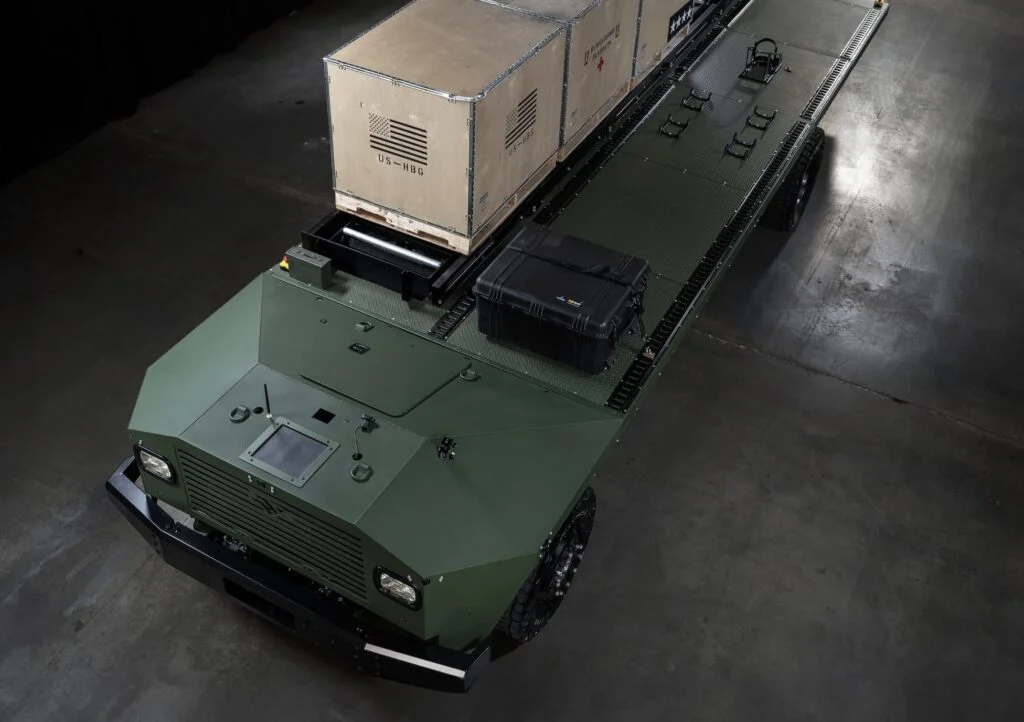
- The Project Sustainment effort will combine Harbinger’s commercial hybrid chassis, Forterra’s autonomous-driving technology and Primordial Labs’ voice-controlled Anura interface.
- The vehicles are intended to support company-sized units with limited human involvement, reduce risks to soldiers and could lead to follow-on orders as the Army expands its autonomous logistics fleet.
American Rheinmetall has received an 18-month U.S. Army contract to develop hybrid-powered autonomous ground vehicles for moving supplies in war zones.
According to American Rheinmetall, the contract is part of the Army’s Project Sustainment effort and is being executed through the National Advanced Mobility Consortium. American Rheinmetall will serve as the prime contractor and work with Harbinger, Forterra and Primordial Labs on the vehicle platform, autonomous-driving system and human-machine interface.
The companies will develop uncrewed ground vehicles designed to support logistics for company-sized Army units and are intended to move equipment and supplies to and from forward positions with limited human involvement, reducing the need to expose soldiers to dangerous transport missions.
American Rheinmetall noted the project fits with the Army’s modernization strategy by combining autonomous operation, hybrid power and commercially derived vehicle technology. Development and testing will take place at U.S. facilities and test ranges.
The contract also includes the possibility of follow-on orders as the Army expands and updates its autonomous logistics fleet.
Commercial Chassis, Military Mission
Harbinger, which develops electric and hybrid medium-duty vehicle platforms, battery systems and drivetrains, will provide a dual-use hybrid chassis designed for commercial and specialty vehicles. American Rheinmetall said the platform can be adapted for military requirements and offers a path toward faster development and scalable production.
Rheinmetall said the approach of adapting commercial vehicle technology for military use is intended to improve affordability, speed production and make it easier to update the vehicles as requirements change.
Forterra will supply the autonomous-driving technology, one designed to support distributed and mission-aware operations in environments where communications, navigation or human oversight may be limited.
American Rheinmetall said that the ability of the vehicles to continue operating with minimal intervention while responding to changing battlefield conditions could reduce the number of soldiers required for routine supply movements and allow personnel to focus on other tasks.
Voice-Controlled Operations
Primordial Labs will provide Anura, a natural-language interface that allows soldiers to control robotic systems through spoken commands.
The system is designed to translate a commander’s instructions into actions for the vehicle, allowing soldiers to operate robots without relying entirely on traditional control equipment. American Rheinmetall said the interface could reduce training time, ease the mental burden on operators and allow one soldier to oversee more robotic systems.
Voice control is one of the program’s central features as the Army explores ways to make autonomous machines easier to use in the field and will allow soldiers to interact with the vehicles more like team members than remote-controlled equipment.
Project Sustainment adds to American Rheinmetall’s portfolio of uncrewed ground systems in the U.S. market. The company said the program will focus on autonomous load handling and transport while improving the Army’s operational reach and reducing risks to soldiers.
American Rheinmetall operates facilities in Michigan, Maine, Ohio and Virginia, while its U.S. munitions business has operations in Arkansas, Texas, Virginia and Maine.
Image credit: American Rheinmetall